
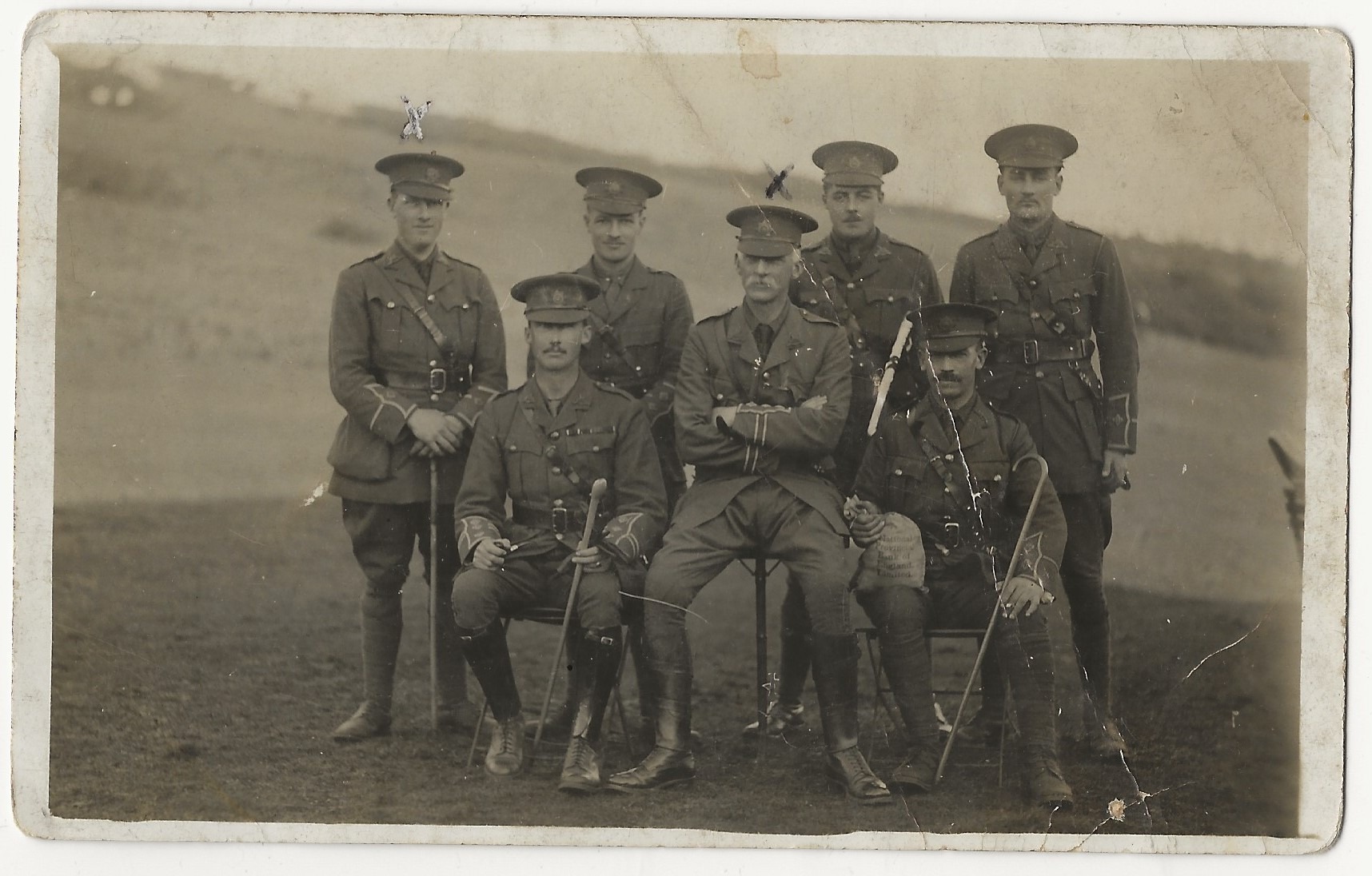
Fred Burkitt was born in Apley, near Wragby, Lincolnshire in 1893. In the 1901 census he is recorded as a seven year old visitor, residing with thirty five year old Fred Glasier, a labourer, at 62 Chapel Lane Nettleham.
By the 1911 census, Fred Glasier has Married Allice in 1902 and Fred is now aged seventeen and is recorded as their stepson. He has a nine year old step sister, Eva, and he is now working as a railway porter.
In August 1914, Great Britain declared war on Germany and like many young men at this time Fred enlisted into the army on 24th September. It is known that he served in C Company of the 7th Battalion of the Lincolnshire Regiment with the service number, 13124. Unfortunately, it does not appear that any record of Fred’s service with the Lincolns has survived.

Kitchener New Army Recruits on Lincoln Racecourse August/September 1914.
The 7th Battalion of the Lincolns were a New Army Kitchener Service Battalion formed at Lincoln in September 1914. They served in the 51st Infantry Brigade in 17th (Northern) Division and landed at Boulogne on 14th July 1915.
The history of 17th (Northern) Division (From www.longlongtrail.co.uk)
This Division was established by the Northern Command in September 1914, as part of the Army Orders authorising Kitchener’s Second New Army, K2. Early days were somewhat chaotic, the new volunteers having very few trained officers and NCOs to command them, no organised billets or equipment. The units of the Division initially concentrated in the Wareham – Lulworth – Swanage – Wool- Bovington area of Dorset but moved in late May 1915 to the Winchester area.
After receiving an order that the Division would be retained for home defence (subsequently cancelled), advance parties left for France on 6 July. Main embarkation began on 12 July and units moved to concentrate near St Omer.
The Division served on the Western Front for the remainder of the war, taking part in many of the significant actions:
1915
The Division spent its initial period of trench familiarisation and then holding the front lines in the southern area of the Ypres salient.
1916
The Division was involved in fighting at the Bluff (south east of Ypres on the Comines canal), part of a number of engagements officially known as the Actions of Spring 1916.
The Battle of Albert* in which the Division captured Fricourt
The Battle of Delville Wood*
The battles marked * are phases of the Battles of the Somme 1916
1917
The First Battle of the Scarpe**
The Second Battle of the Scarpe**
The Capture of Roeux**
The battles marked ** are phases of the Arras Offensive
The First Battle of Passchendaele***
The Second Battle of Passchendaele***
The battles marked *** are phases of the Third Battles of Ypres
It is known from family photographs that Fred had two wound stripes on his uniform. Without a surviving service record it is impossible to tell his tale with certainty, but it is believed that he was wounded in the summer /autumn of 1917 during the Third Battle of Ypres.
After recovering from his wound, Fred was drafted into the Leicestershire Regiment with the rank of corporal. His service number, 52118, is in a batch of numbers allocated to the 6th Battalion and it is likely that he joined his new regiment at some point in early 1918.
Fred’s Medal Index Card for his service with the Leicester’s has survived and records his date of enlistment and his date of discharge in March 1919 – he was discharged under King’s Regulations as ‘Being No Longer Physically Fit For War Service ‘, suggesting that Fred was wounded for a second time during 1918 – His Silver War Badge (For Wounds Received) record has survived and he was awarded Badge No. B202909.
The 6th Leicester’s were originally formed as a New Army Kitchener Service Battalion in September 1914. The 6th, 7th, 8th and 9th Battalions of the Leicester’s formed the 110th Infantry Brigade and they were transferred to 21st Division in July 1916.
The History of 21st division in 1918 when Fred served with them.
1918
The Battle of St Quentin+
The First Battle of Bapaume+
The battles marked + are phases of the First Battles of the Somme 1918The Battle of Messines=
The Second Battle of Kemmel=
The battles marked = are phases of the Battles of the Lys 1918
The Battle of the Aisne 1918
The Battle of Albert++
The Second Battle of Bapaume++
The battles marked ++ are phases of the Second Battles of the Somme 1918
The Battle of Epehy^
The Battle of the St Quentin Canal^
The Battle of Cambrai 1918^
The battles marked ^ are phases of the Battles of the Hindenburg Line
The Battle of the Selle, a phase of the Final Advance in Picardy
When the Armistice came into effect at 11am on 11 November 1918 the units of the Division were halted around Berlaimont. Next day they moved to Beaufort, going between 12-20 December to west of Amiens. Demobilisation began and by 19 May 1919 the Division ceased to exist.
Further information can be found on this web site http://www.21stdivision1914-18.org/
It is not possible to say when Fred received his second wound in 1918 but it is likely that he would have seen action in some or all of the above battles. For his service from 1915-18, Fred would have been awarded a 1915 Star and the British War and Victory Medals.
Both the 7 Lincoln’s and the 6 Leicester’s War Diaries are now available on line at the National Archives http://www.nationalarchives.gov.uk/help-with-your-research/research-guides/british-army-war-diaries-1914-1922/
There is also a book covering the history of the Leicester Brigade (6, 7, 8 & 9 Battalions) http://www.amazon.co.uk/Tigers-Service-Battalions-Leicestershire-Regiment/dp/0850527406/ref=sr_1_1?s=books&ie=UTF8&qid=1445540513&sr=1-1&keywords=6th+battalion+the+Leicestershire+regiment