
‘The December issue of Derbyshire Life has an interesting article about a scrapbook that was discovered at a house clearance in Derby.
The scrapbook had belonged to a Maude Alice Lineham – she was a VAD nurse who served at Spondon House Hospital and the Derbyshire Royal Infirmary. The article includes an account of the truce entitled “Peace on Earth” written by a Private John J Ferguson who was severely wounded at Messines on the December 26th 1914. His account was written while at the DRI and also pays tribute to the nursing staff there.
The scrapbook album was sold at auction in November 2024 for £3,400. The article doesn’t say who bought it – the editor must have access to it has images of the article.’

John Ferguson served with the 2nd Battalion Seaforth Highlanders and was badly wounded on Boxing Day 1914, a wound which resulted in the loss of his arm.
There were many John Ferguson’s who served with the Seaforths, but I think this is the John Ferguson in question. Arrived August 1914 and formally discharged from the army.
I initially believed this to be a new and unknown account in which Ferguson clearly states that men from both sides met in No Man’s Land and that there was a football kick-about between men of B Company of his battalion, but the idea that there was a Britain v Germany game is a complete non-starter!
However, one of the best researched books about the Christmas Truce – “Christmas Truce” by Malcolm Brown and Shirley Seaton – ISBN 0 330 39065 1 – which was first published in 1984, contains a full reference to John Ferguson’s account on page 61. The plot thickens!
The idea that Maude’s scrapbook was discovered after being tucked away for 100 years is obviously not the case, Brown and Seaton were aware of its existence back in the 1980’s. Nevertheless, it is a remarkable eye-witness account and whoever paid £3,400 for it has a real snapshot of history from a man who was actually part of it.
When we talk of the Christmas Truce, we are immediately thinking of the trenches near to Ploegsteert (Plugstreet to the Tommies) on the Franco – Belgian border, here the truce was widely witnessed and reported on by many men and officers, including Bruce Bairnsfather, the Great War soldier and famous cartoonist.
However, accounts exist of fraternisation between opposing soldiers in Flanders and on the 23rd December as well as Christmas Eve and Christmas Day. In fact, the so called Truce officially ended for the British by an Army Order dated 3rd January 1915.
Lieutenant Malcolm Kennedy of 2/Cameronians wrote; ‘….one of the men on sentry duty called my attention to the fact that the German troops opposite were clambering out into the open, waving their arms in the air and making friendly gestures in our direction. As they were unarmed and showed no signs of hostile intention, I was wondering what to do when a message came along from the Company Commander saying, “Don’t shoot, but count them.” Kennedy continues; ‘…..the Company on our left, however, allowed a couple of Germans to come across and a friendly exchange of cigars took place, one of the two Germans jocularly remarking that he hoped the war would end soon, as he wanted to return to his former job as a taxi-driver in Birmingham.’
Vize-Feldwebel Lange a Saxon NCO recorded that Saxon soldiers put up Christmas trees on the parapet of their trench on the night of the 23rd, upon which a number of Tommies – who had had previous parleys with the enemy to exchange tinned meat and tobacco – came over to ask what the trees were for. Told that it was a custom at Christmas, two of the Tommies hurried away, returning shortly to say that two of their officers were waiting beyond the wire anxious to speak with the Major in charge. The officers proposed a private truce for Christmas Eve and Christmas Day. The idea was accepted.
Christmas Eve 1914 also holds one other significant moment in 20th century history. It was the day when the first bomb fell on mainland Britain. At 11am, a solitary German aircraft dropped a bomb towards Dover castle. The bomb missed and landed in the garden of Thomas Terson JP, blowing a John Banks out of a tree in the Rectory garden next door, where he was cutting evergreens for the Christmas decorations in the church.
The 2/Cameronians were due to be relieved on the evening of the 24th and Lieutenant Kennedy recorded that the Germans showed no signs of resuming hostilities and that ‘………occasionally the guttural tones of a German were to be heard shouting out lustily, “A Happy Christmas to you Englishmen”. Only too glad to show that the sentiments were reciprocated, back would go the response from a thick-set Clydesider, “Same to you, Fritz, but dinna o’er eat yourself wi’ they sausages.” ‘
Word of these early episodes soon reached Sir John French’s High Command HQ at St. Omer and he ordered a signal sent to all units – “It is thought possible that the enemy may be contemplating an attack during Xmas or New Year, Special vigilance will be maintained during this period.”
The same thought also struck the Germans. An order was issued to 133rd Saxon Infantry Regiment which noted; ‘………it was expected that the English would perhaps take advantage of our good mood at Christmas by mounting a raid.’
On Christmas Eve, Johannes Niemann, a Lieutenant in the 133rd Saxon IR wrote; ‘We posted a tiny Christmas tree in our dugout – the Company Commander, myself the lieutenant, and the two orderlies. We placed a second lighted tree on the breastwork. Then we began to sing “Stille Nacht, Heilige Nacht” (Silent night, holy night).
It is believed that on about two-thirds of the British held sector, Tommies watched in amazement as lighted Christmas trees and lanterns appeared on the German parapets.
Albert Moren of 2/Queen’s was in the front line trenches at La Chapelle d’Armentieres and noted that ‘It was a beautiful moonlit night, frost on the ground, white almost everywhere: and about seven or eight in the evening there was a lot of commotion in the German trenches and there were these lights – I don’t know what they were. And then they sang “Silent Night”. I shall never forget it, it was one of the highlights of my life.’
The Tommies responded with calls for more and carols of their own. Charles Brewer, a Lieutenant in the 2/Bedfordshires said that ‘…when the Germans stuck up the famous German carol “O Tannenbaum”,’ his men replied ‘less artistically but no less heartily’, with ‘We are Fred Karno’s army’.
Johannes Niemnann remembered the British singing ‘It’s a Long Way to Tipperary’ and ‘Home Sweet Home’.
The lads of the London Rifle Brigade, being a well-educated lot, held a full scale concert with their opponents. Rifleman Graham Williams, remembered that after the Germans had sung Silent Night; ‘….we sang “The First Nowell (sic)’, and when we finished they all began clapping; and they struck up another favourite of theirs, “O Tannenbaum”. And so it went on. First the Germans would sing one of their carols and then we would sing one of ours, until we started up “O Come All Ye Faithful” the Germans immediately joined in singing the same hymn to the Latin words “Adeste Fideles”. And I thought, well, this was really a most extraordinary thing – two nations both singing the same carol in the middle of a war.’
It was at this point, as soldiers settled down to try and sleep, that the first instances of fraternisation in No Man’s Land took part. Second Lieutenant Bruce Bairnsfather, the Machine Gun Officer of the 1/Royal Warwicks, and later the famous cartoonist, was returning to the trenches after enjoying a Christmas dinner and he noted that a Boche band was attempting to play Deutschland, Deutschland Uber Alles when ‘…suddenly we heard a confused shouting from the other side. We all stopped to listen. The shout came again. A voice in the darkness shouted in English, with a strong German accent, “Come over here”. A ripple of mirth swept along our trench, followed by a rude outburst of mouth organs and laughter. Presently, in a lull, one of our sergeants repeated the request, “Come over here”
‘After much suspicious shouting, our sergeant went along the hedge. He was quickly out of sight; but as we all listened in breathless silence, we soon heard a spasmodic conversation taking place out there in the darkness.’
Private Tapp confirmed this meeting and wrote; ‘Our sergeant goes out, their man takes a lot of coaxing but comes at the finish and we find that they have sent two, we can hear them talking quite plain, they exchange cigarettes and the German shouts to wish us a Merry Christmas.’
When the sergeant returned, he brought with him cigars and cigarettes which he had swapped for two tins of Maconochie’s and a tin of Capstan tobacco. He also brought back an offer from the Germans not to fire until Boxing Day unless the British fired first. Bairnsfather’s comrade, Lieutenant Black noted that ‘we were strolling about outside the trenches as though there was no war going on.’
A much longer fraternisation went on between the trenches at Ploegsteert, and this is where John Ferguson’s account, at the start of this article, happened. If you haven’t clicked on the links above, Ferguson noted that the Germans were calling to the Tommies and Ferguson replied; ‘”Hello Fritz.” “Do you want any tobacco” he asks, “Yes,” “come halfways”, we shouted back and forward until Old Fritz clambered out of the trench, and accompanied by three others of my section we went out to meet them.’
Christmas Day dawned and all along the British front, individual instances of fraternisation and temporary truces came into being. Most British accounts suggest that it was the Germans who made the first overtures, just as they had started the carol singing the previous night, but two German accounts suggest otherwise.
One German wrote; ‘….we came up from our mouse holes and saw the English advancing towards us, they had no rifles with them, and therefore we knew it could only be a greeting and that it was all right. We advanced towards them about halfway.’
Another German account states; ‘At about 9am on Christmas Day an English officer, accompanied by two of his men, came across and asked for a cease fire until midnight to bury the dead. This was willingly granted.’
Not everyone agreed with the truce, and an officer of the Rifle Brigade had ordered his men, the night before, to shoot down the German Christmas trees, but now he was overtaken by the speed of events and found himself conversing with the Germans and eventually collaborating with the enemy to bury the dead. He wrote; ‘The Germans came out, and as soon as we saw they were Saxons I knew it was all right, because they’re good fellows on the whole [The British saved their loathing for Prussians – Ed] and play the game as far as they know it. The officer came out; we gravely saluted each other, and I then pointed to nine dead Germans lying in midfield and suggested burying them, which both sides proceeded to do. We gave them some wooden crosses, which completely won them over, and soon the men were on the best of terms and laughing.’
The wholesale burying of the dead carried on apace all along the front and near to Fleurbaix, a parley between the Chaplain of the Gordon Highlanders, the Reverend J Esslemont Adams, and senior German officers led to a major repatriation of bodies which were carried to the mid-point of No Man’s Land. Here the bodies were sorted out and a British and a German digging party set to work and the Reverend Adams presided over the burials reading the 23rd Psalm whilst prayers were said in both English and German. The Germans wouldn’t repatriate the British rifles though!
At the end of the service, the Chaplain stepped forward and saluted the German commander, who shook hands with him and bade him farewell. The 6/Gordon Highlander’s War Diary recorded that it was; ‘..an impressive sight, officers and men, bitter enemies as they were, uncovered, reverent, and for the moment united in offering for their dead the last offices of homage and honour.’

Gordon Highlanders in No Man’s Land Christmas 1914.
In some sections of the line, especially if there was a Prussian regiment opposite, no truce or fraternisation occurred. Hostilities continued and in some sectors, men who believed they were safe were shot dead by the treacherous Hun.
Sergeant Blackwood James noted that; ‘I took some tobacco and jam to the Germans. But, never no more. Another sergeant, a pal of mine from Monmouth, did the same, but when he was coming back to the trench they shot him through the back and killed him. He fell down and said “My God, I’m done”. They are dirty cowards, after giving them tobacco.’
The dead man was sergeant Frank Collins, a 39 year-old, married man with three children. His official records state Killed in Action – the action in which he was killed was taking Woodbines to the Hun. The Germans, believe it or not, subsequently sent a letter of apology.
The 1/Leicester’s had two men killed and three wounded whilst a truce was in place, so dear TL reader, please do not believe that the Paul McCartney video is a truthful depiction of the 1914 Christmas truce.
Perhaps the most enduring theme of the 1914 Christmas Truce is the idea that a football match took place. There is no evidence for this at all, although it is well reported that kick-abouts did take place in No Man’s Land.
It is even suggested that attempts were made to organise a football game, but the idea was quashed by senior officers who thought it a step too far.
There is no confirmed case of an organised match being mentioned by either a British or German soldier who occupied the same sector of the front line at the same time, there is, however, evidence to suggest at least one ad-hoc kick-about took place between the two sides that day. Interviewed by The Evening News while on home leave just days after the truce, CSM Frank Naden of the 6th Cheshire Regiment spoke of his experience in the sector of line near Wulverghem:
“On Christmas Day one of the Germans came out of the trenches and held his hands up. Our fellows immediately got out of theirs, and we met in the middle, and for the rest of the day we fraternised, exchanging food, cigarettes and souvenirs. The Germans gave us some of their sausages, and we gave them some of our stuff. The Scotsmen started the bagpipes and we had a rare old jollification, which included football in which the Germans took part. The Germans expressed themselves as being tired of the war and wished it was over.”
Almost seventy years later another soldier from the 6th Cheshire’s, Ernie Williams, spoke of the encounter near Wulverghem in a television interview. He also made it quite clear that it was not an organised match.
“The ball appeared from somewhere, I don’t know where, but it came from their side – it wasn’t from our side that the ball came. They made up some goals and one fellow went in goal and then it was a general kick-about. I should think there were a couple of hundred taking part… There was no referee and no score, no tally at all. It was simply a melee.”
What definitely did happen though, is that pre-war barbers set up cutting the hair of friend and foe alike, and men who knew each other before the war met once again. Bruce Bairnsfather recalled that; ‘….a machine gunner who was a hairdresser in civilian life, cut the hair of a docile boche, who was patiently kneeling on the ground whilst the clippers crept up the back of his neck.’
Equally, not everyone who walked in No Man’s Land had honourable intentions. Many men took the opportunity to inspect the enemy trenches with a view to future actions. Billy Congreve noted that his ‘…best friend had had a cigar with the best shot in the German army, who had killed more than a dozen of us, but I now know where his loophole is and I mean to mow him down tomorrow.’
I hope you have enjoyed this brief foray into the Christmas Truce of 1914, the majority of the text above has been taken from the research of Malcolm Brown and Shirley Seaton, and if this particular topic really whets your appetite, please buy the book which can be found on Amazon and other sites. The Derbyshire Life link came from Philip Ward. Thank you.
Christmas Truce: The Western Front December 1914: Amazon.co.uk: Brown, Malcolm, Seaton, Shirley: 9781447264279: Books


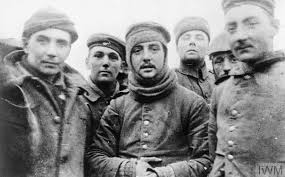
These pictures are probably the most well-known surviving photographs from Christmas 1914. It was shortly after Christmas 1914, that the authorities forbade soldiers taking private photos in the trenches, and having a Kodak Vest Pocket camera in your possessions would lead to a serious charge.
Unfortunately, recent centenary events and what I call a growing sentimentality, have led to the erection of ridiculous memorials on the Western Front. Regular and long term TL readers will know of my dislike of modern ‘mushy’ memorials. Here are a couple that have seriously made me shake my head in recent times!

This memorial of two soldiers meeting in No Man’s Land can be found in the main square in the village of Messines.

This absolutely awful football memorial can be found near Ploegsteert, opposite the field where it is suggested a football game took place, and close to the site of Bruce Bairnsfather’s dug-out.