Undoubtedly, the Australians were a supremely tough and uncompromising element for the British Army to handle both in the Gallipoli campaign and on the Western Front.
The Australians would not agree to their men being subject to Capital Punishment, and this may have contributed to their well recorded lack of discipline, especially when behind the lines. Let loose in London and in French towns, their drinking and wenching, led to record numbers of men unfit for duty with venereal disease. Their disregard for ‘spit and polish’ and ‘bull’ was well known, and they were not readily deferential to senior officers when on leave.
However, when in the offensive, they were supreme in their dogged determination to take the fight to the enemy. The downside of this ferocious reputation was the fact that they were probably thrown into the attack more often than they deserved, especially on the Somme at Pozieres and Mouquet Farm in the summer of 1916.
Their commander, Sir John Monash, was not a regular soldier before the war, and his forward thinking and tactical nous was second to none. Monash was even suggested as a possible replacement for Haig in early 1918.
As battlefield tactics evolved, especially the advent of all arms offensives led by tanks in 1918, the Australians proved themselves to be the masters as demonstrated at Hamel and at Amiens in July and August.
Australia twice voted against conscription, but such was their loyalty to the mother country with many of the troops having been born in the UK, that the Australians fielded five divisions on the Western Front. In comparison, New Zealand, with a smaller population fielded just one division, but nevertheless, their contribution was outstanding in 1917 at Passchendaele and in the Advance to Victory of 1918.
The general discipline and behaviour of the New Zealanders is said to be much better than that of the Australians, although, there will be instances of poor behaviour with every army if you look hard enough.
The text book capture of Le Quesnoy by the New Zealanders in November 1918 sums up how much they had learnt over the course of the war. Led by Major General Sir Andrew Russell on the Western Front, the three New Zealand rifle brigades carried on the good work that had be seen in Gallipoli in 1915.
Ah! I hear you say, but what about the Canadians?
Yes, the Canadian army, like the Australian and New Zealand armies, contained as many as one-third British born soldiers. Young men who had set off for the colonies to find fame and fortune, rallied to the call of the Mother Country on the outbreak of war.
Canada, being an immense geographical country, found its nationhood during WWI when men from all regions came together to form the Canadian Expeditionary Force. In due course, Canada, like Australia, fielded five divisions on the Western Front under the command of Sir Arthur Currie, like Sir John Monash, a man of great intellect and tactically forward thinking, not hidebound in the ‘old ways’ in the sense that many British generals were.
The Canadians first came to prominence in April 1915 when their first arrivals in Flanders stemmed the German offensive after the Germans had used gas for the first time to break the line held by French colonial troops north-east of Ypres.
However, their most noticeable achievement in the historiography of the Great War, is the first time that all five Canadian divisions fought side by side on the opening day of the Battle of Arras in April 1917. On this day, after meticulous planning, the Canadians (with the help of 51st Highland Division on their right flank) captured Vimy Ridge, the high point of the terrain that overlooks the Douai Plain and the coal mining area of north-east France. This is the day that historians suggest that Canada became a unified nation.
After this battle, the Canadians were withdrawn from the line and allowed to re-fit and rest until October 1917. At this point Haig required, in his usual manner, ‘One More Push’ to take the remnants of Passchendaele village and its surrounds. The British army was exhausted and depleted after slogging through the Flanders mud from the previous August. The Australians and the New Zealanders had already played their part, most noticeably in the capture of Polygon Wood and the land where Tyne Cot cemetery now stands.
Haig called on Currie for the final slog up the Passchendaele ridge. Currie had to obey orders but told Haig that it would cost the Canadians 16,000 casualties.
The Canadian push (aided by British troops on the flanks) commenced on 26th October and the destroyed village of Passchendaele was captured by the Winnipeg battalion on 6th November. The total casualties sustained by the Canadians in this ‘push’ was 4,000 dead and 12,000 wounded – Currie’s prediction had proved to be correct.

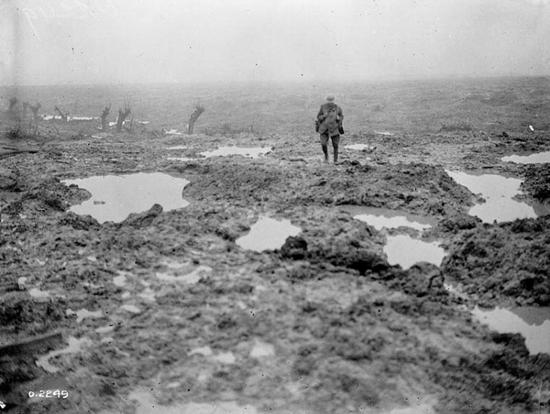
Canadian Machine Gunners in the Flanders Mud.
The Canadians, like the Australians, suffered from overuse because they were so reliable and good at their job. They played a very full and active part in the final 100 day’s advance to victory.
All of the above is not written to denigrate the British soldiers at the front. Jon Sandison and many others will tell you that the Scottish soldiers, particularly the kilted highland regiments, were the best soldiers on the Western Front. They were feared by the Germans who allegedly referred to them as the ‘Devils in Skirts’ and the ‘Ladies from Hell’ – although academics will tell you that this is a myth. Nevertheless, the Scottish regiments have always played a full part in British military history over the last three centuries, notably at Waterloo and in the Crimea.
The 51st (Highland) Division ended the Great War with a fearsome reputation despite being Territorials, rather than regular soldiers. They do however, have one blot on their history through no fault of their own. Their commanding officer at the Battle of Cambrai in November 1917, Major General George Harper refused to embrace the new tactics of mutual infantry and tank support, and as a result tanks and infantry suffered in the stunning advance of November 20th – this led to the division being known as ‘Harper’s Duds’.
Lord Kitchener’s New Armies played a full role in the war and the 9th and 15th (Scottish) Divisions both ended the war with a very good reputation for taking the attack to the enemy. Professor Peter Simkins has written extensively about the successful exploits of the K2 18th (Eastern) Division which was led by a very forward thinking commander, Sir Ivor Maxse.
The 18th Division succeeded on 1st July 1916, to capture all of their objectives. Maxse had sent his men out into No Man’s Land, and they closely followed the final artillery barrage and so assaulted the German front line trenches before the Germans had time to come up from their dugouts and set up their machine guns. The ‘creeping barrage’ with men following closely behind, became a staple tactic as the war progressed into 1918.
Maxse’s reputation saw him promoted to a Corps Commander in 1917, and in June 1918 he became Director General of Training for the British Army, in an effort to unify tactical knowhow. The question we must ask, is not necessarily how good the troops were, but how were they led?
A good example of this is our very own 46th (North Midland) TF Division. On 1st July 1916, the opening day of the Somme offensive, they, along with the 56th (1st London) Division, were given the impossible and suicidal task of making a completely unsupported attack against the Gommecourt Salient. According to Haig’s diaries, the idea behind this attack was to draw fire upon themselves so as to aid the attack at Serre, some two miles to the south by the Northern Pals battalions from Sheffield, Barnsley and Accrington.
There was no plan in place to support this isolated attack, and no plan in place should it be successful. On the day it was a bloody disaster, just as it was at Serre where they waited for the barrage to end before leaving the trenches, and was in complete contrast to Maxse’s 18th Division’s success further south.
If you have seen my talk on Gommecourt, you will know that I believe it was Haig’s personal animosity with Major General Stuart-Wortley, commanding 46th Division, which led to the 46th Division being the only division to face a Court of Enquiry after the debacle of the opening day of the Somme offensive. The 46th Division were accused of lacking ‘offensive spirit’, in short, cowardice.
If we then go forward to 29th September 1918, the 46th Division, which by now had adapted to the new tactical doctrines and was given an attack plan properly supported by overwhelming artillery fire support and attacking troops with tanks on both flanks, they became the first British division to breach the Hindenburg Line, when the Staffordshire Brigade captured the Riqueval Bridge intact.
The Daily Mirror described this as the ‘Best Feat of Arms by a British Division in the War’ – a complete contrast to the suggestion of cowardice two years earlier.
As for the Regular Divisions of the British Army, those that arrived on the Western Front in 1914 were all but destroyed and were non-existent by early 1915 in terms of original manpower. However, a core remained and around this core came the replacements, and as the battalion ethos survived, so did the battalion. All battalions and divisions were re-built, often more than once and so the British Army survived and learnt to endure the hardships of trench warfare.
The first six divisions to form the BEF in 1914 all served to the war’s end with new faces appearing as required, the 29th Division, hastily thrown together from regular battalions that returned from Empire outposts, performed well in Gallipoli and France and Flanders, and of course, the Guards Division, formed in 1915 by amalgamating Guards battalions serving in other divisions into one division, and with the birth of the Welsh Guards in 1915, went on to serve with distinction in all of the major battles from Loos to the Armistice.
Therefore, I would suggest that all of the men who served in the Great War did ‘their bit’, and that every battalion would contain good, bad and indifferent soldiers. What really counted was leadership, morale and when properly trained and led, this led to an elan and esprit de corps, that the Germans could not match. When this manpower superiority was combined with the Anglo-American economies supply of materiel, a war winning formula was eventually found.
Monash, Currie and Maxse stand out as clear and forward thinking generals, I also think that Smith-Dorrien may have made an excellent commander if he hadn’t lost his field command in May 1915 due to a spat with Sir John French, but on the other hand, generals like Haking, Townshend and Gough pay the price for their war records, and are held up as examples of ‘Butcher’s and Bunglers’. As I said earlier, there were good, bad and indifferent men at all ranks of the allied armies.
