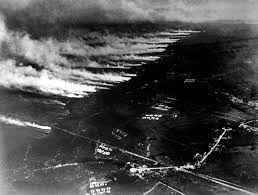
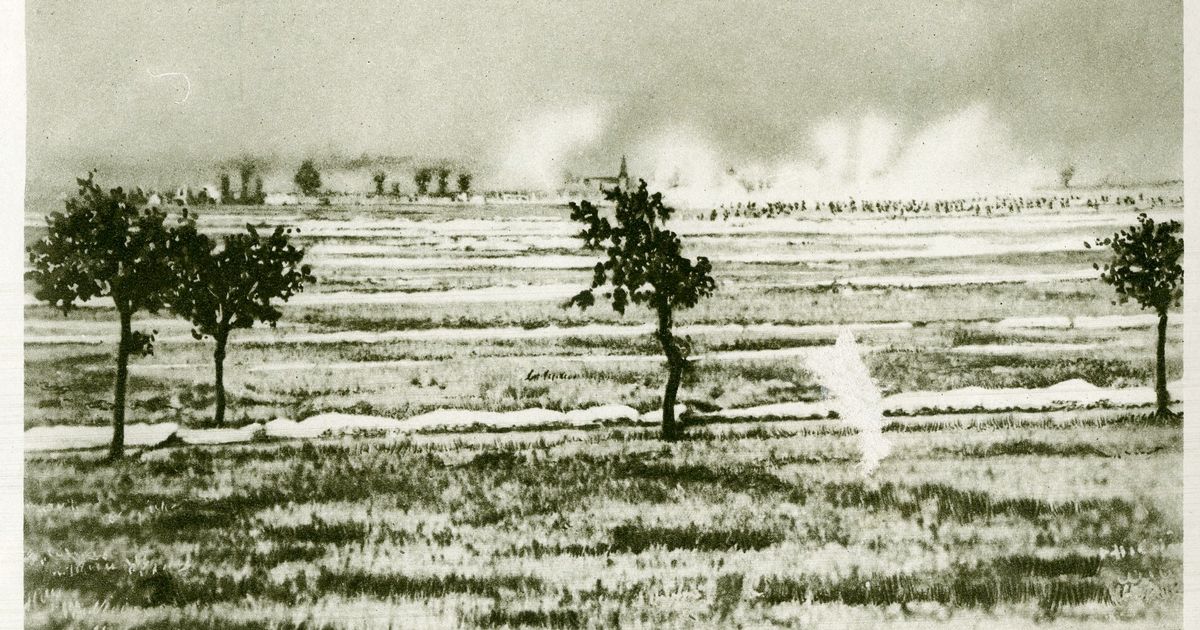
Of great importance in the historiography of the First World War is the first use of gas by the Germans.
On 22nd April 1915, during the early stages of the Second Battle of Ypres in Belgium, German forces carried out the first large-scale use of poison gas on the Western Front, introducing a new and terrifying form of industrialised warfare. Although smaller experiments with chemical irritants had occurred earlier in the war, this marked the first successful deployment of lethal gas against enemy troops. The attack not only shocked Allied forces but also transformed the nature of World War I, leading to an escalating cycle of chemical weapons development and countermeasures.
By the spring of 1915, the Western Front had settled into a stalemate. Opposing armies stretched from the North Sea to Switzerland, entrenched behind barbed wire, machine guns, and artillery. Repeated offensives had produced massive casualties with little territorial gain. German commanders sought a method to break this deadlock, and attention turned to chemical weapons. German scientists, including chemist Fritz Haber, advocated the battlefield use of chlorine gas. Chlorine, a greenish-yellow industrial chemical, irritates the lungs and, in sufficient concentration, causes death by asphyxiation. When inhaled, it reacts with moisture in the respiratory tract to form hydrochloric acid, severely damaging tissues and making breathing impossible.
The Germans prepared their attack carefully. Along a roughly six-kilometre section of front near Ypres, they placed thousands of metal cylinders filled with compressed chlorine gas in their forward trenches. These cylinders were not fired like shells; instead, the plan depended on releasing the gas when the wind blew toward Allied lines. This method was risky, as shifting winds could send the gas back toward German troops, but favourable conditions developed late in the afternoon of 22nd April. At approximately 5 p.m., German soldiers opened the cylinder valves.
A dense cloud of chlorine gas drifted slowly across no-man’s-land toward the Allied positions. Opposing the Germans were French colonial troops, including Algerian and Moroccan units, as well as some territorial divisions. Many soldiers initially watched the strange cloud with curiosity, unaware of the danger. As the gas reached the trenches, confusion quickly turned to panic. Soldiers began coughing violently, choking, and clutching their throats. Eyes burned, lungs filled with fluid, and many collapsed in agony. Without protective equipment, the troops had little defence. Some attempted to cover their faces with cloths, while others fled in desperation.
The gas attack created a four-mile gap in the Allied line. French colonial units, suffering heavily, withdrew, and the sudden collapse threatened to open a path toward Ypres. However, German forces hesitated. The attack’s success had been greater than anticipated, and German infantry were cautious about advancing into the lingering gas cloud. Moreover, they lacked sufficient reserves to exploit the breakthrough immediately. This hesitation allowed nearby Allied units, particularly Canadian divisions, to move into the gap and improvise defensive positions.
Canadian troops, facing renewed gas attacks in the following days, quickly developed crude countermeasures. Soldiers urinated on cloths or handkerchiefs and held them over their mouths and noses, believing the ammonia in urine might neutralise chlorine. While only partially effective, such improvisations helped reduce casualties. The Allies soon began distributing basic respirators, and within months both sides developed increasingly sophisticated gas masks. The introduction of chemical weapons thus triggered an arms race in both offensive and defensive technologies.
The use of chlorine gas on 22nd April 1915 shocked the world. Although international agreements such as the Hague Conventions of 1899 and 1907 had discouraged the use of poison weapons, the Germans argued that releasing gas from cylinders did not technically violate the ban on poison projectiles. Regardless of legal interpretations, the psychological impact was profound. Reports from survivors described a battlefield filled with choking men, abandoned equipment, and bodies lying where soldiers had fallen. The horror of death by suffocation, combined with the invisibility and unpredictability of gas, created deep fear among troops on all sides.
The immediate tactical results of the attack were limited. Although the Germans gained some ground, they failed to capture Ypres or achieve a decisive breakthrough. Nevertheless, the precedent had been set. Soon, all major combatants began developing and using chemical weapons. The Allies introduced their own gas attacks later in 1915, and over time more lethal agents, including phosgene and mustard gas, were deployed. Mustard gas, introduced in 1917, caused severe burns and long-lasting contamination, further increasing the suffering of soldiers.
In retrospect, the German gas attack at Ypres marked a turning point in modern warfare. It demonstrated how scientific knowledge and industrial capacity could be harnessed to create new methods of killing. The attack also illustrated the moral ambiguities of total war, as nations justified increasingly destructive weapons in the pursuit of victory. Although chemical weapons caused a relatively small proportion of total World War I casualties compared to artillery, their psychological impact was enormous.
The events of 22nd April 1915 remain significant not only as a military innovation but also as a warning. The horror experienced by soldiers at Ypres contributed to later international efforts to ban chemical weapons, including the Geneva Protocol of 1925. The first successful use of chlorine gas by German forces thus stands as a grim milestone—an episode that revealed both the ingenuity and the destructive potential of modern science when applied to warfare.