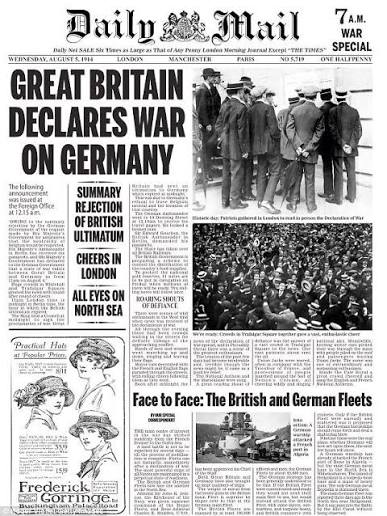
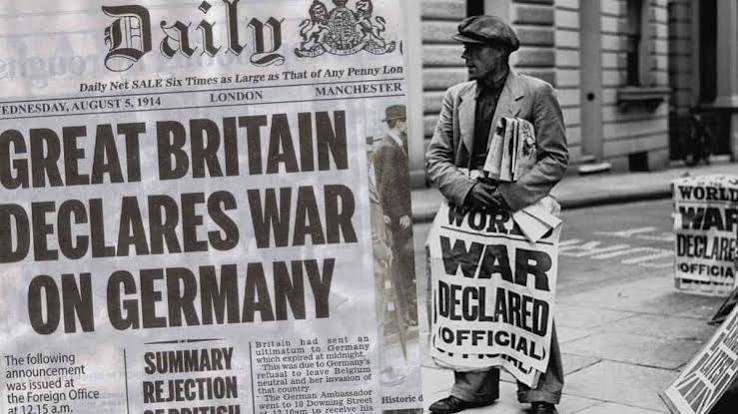
4 August 1914
The lead up to Britain’s declaration of war
▪ At the beginning of the twentieth century, Britain was one of the greatest powers in the
world, with one in four people owing allegiance to the British Crown.
▪ By 1907 Europe was split into two main camps: Germany, Austria-Hungary and Italy in
one – The Triple Alliance – and France, Russia and Britain in the other – The Triple
Entente.
▪ 28 June 1914, Serbian-backed terrorist, Gavrilo Princip, shot dead Archduke Franz
Ferdinand, heir to the Austro-Hungarian throne. With German encouragement, this led to
Austria-Hungary’s declaration of war against Serbia one month later on 28 July 1914.
▪ This declaration of war drew in allies and supporters on both sides. Germany supported
Austria-Hungary and Russia stood by the Serbs.
▪ 3 August 1914, Foreign Secretary Sir Edward Grey addresses the House of Commons
on Britain’s position in the crisis.
▪ The British government, led by Prime Minister Herbert Asquith, agonised over whether to
support France and Russia or to remain neutral but it feared a German domination of
Europe would result if France and Russia were beaten. A victorious and hostile Germany
would threaten Britain’s security and its position in the world.
▪ Germany’s invasion of Belgium, to get to France, tipped the balance as ever since 1839
Britain had guaranteed both Belgium’s neutrality and independence.
4 August 1914 Timeline
Note: In August 1914 London, Paris and Brussels were all on the same time while Berlin and
Vienna were one hour ahead, and St Petersburg two hours ahead. All times given here are local
times.
Midnight – London: In the Personal Column of The Times, the advertisement “To all who call
themselves English gentlemen – are you drilled and ready to defend your
country?” appears. On the same page, the Austro-Hungarian Government
calls on all reservists in Britain to report without delay to the Consulate-
General
6am – Foreign Ministry, Brussels: German Minister in Brussels delivers a note which informs
the Belgian government that after their refusal of free passage, Germany
would now be obliged to carry out measures for her own security and “if
necessary by force of arms.”8.02am – Gemmerich, German-Belgian border: First German troops cross the frontier and
begin the invasion of Belgium. They meet resistance from Belgian
gendarmes.
9.30am – Foreign Office, London: Telegram is sent to British Embassy in Berlin where
Ambassador Sir Edward Goschen is instructed to tell Germans that Britain
was “bound to protest against this violation of a treaty to which Germany is
a party… and must request an assurance that the demand made upon
Belgium will not be proceeded with, and that her neutrality will be respected
by Germany.”
11am – Royal Palace, Brussels: Official news of the German invasion reaches Brussels.
12 noon – Royal Palace, Brussels: King Albert I and his ministers draft an appeal to Britain,
France and Russia for “concerted and common” military action against the
German invaders. The King adds: “Belgium is happy to declare that she will
assume the defence of her fortified places.”
2pm – Foreign Office, London: Foreign Secretary Sir Edward Grey telegraphs an ultimatum to
Berlin, requesting the German government to make assurances that it
would respect Belgian neutrality as guaranteed by the 1839 Treaty of
London. A reply is requested by 11pm (midnight Berlin time).
3pm – British Embassy, Berlin: The 9.30am telegram from the London Foreign Office arrives
at the embassy in Berlin
4.20pm – Foreign Office, London: A telegram giving the official confirmation of the German
invasion of Belgium arrives from the British minister in Brussels.
6pm – British Embassy, Berlin: The 2pm telegram from London, giving the ultimatum, arrives
in Berlin. After a visit to the foreign ministry, Ambassador Sir Edward
Goschen requests a meeting with Reich Chancellor Bethmann-Hollweg
9pm – Foreign Office, London: Telegrams warning British diplomatic and consular missions
around the world of Britain’s impending declaration of war are sent out.
9.05pm – 10 Downing Street, London: Prime Minister Asquith summons Chancellor of the
Exchequer, David Lloyd George, and other senior members of the cabinet
for consultation. They are told of an intercepted telegram from Berlin to the
German ambassador falsely stating that Britain declared war on Germany
at 7pm Berlin time.
9.40pm – Foreign Office, London: Another false report is received that Germany has declared
war on Britain. Junior Foreign Office official Lancelot Oliphant is sent to the
German Embassy with a hastily typed British declaration of war.
10pm – British Embassy, Berlin: A howling mob outside the embassy start throwing stones at
the windows, breaking most of them and forcing Sir Edward Goschen and
his staff to seek refuge on the first floor. A formal apology is later personally
delivered by foreign minister Gottlieb von Jagow.
10.15pm – Foreign Office, London: Oliphant returns from the German Embassy to find that the
report of a German declaration of war was false. A fresh declaration of war
is typed up ready to be taken round to Ambassador Prince Karl
Lichnowsky.
10.45pm – Buckingham Palace, London: King George V holds a Privy Council to declare war
on Germany: “It is a terrible catastrophe but it is not our fault.”
11.05pm – German Embassy, London: Junior Foreign Office official Harold Nicolson arrives in
the Foreign Secretary’s Rolls Royce with the new declaration of war and
instructions to retrieve the one Oliphant brought earlier.11.20pm – 10 Downing Street, London: First Lord of the Admiralty Winston Churchill, reports
to the Prime Minister and Cabinet colleagues that a wireless message had
been sent to all Royal Navy warships announcing that Britain was now at
war with Germany: “War, Germany, act.”
11.30pm – 10 Downing Street, London: David Lloyd George leaves the Prime Minister’s
residence: “…I felt like a man standing on a planet that had been suddenly
wrenched from its orbit by a demoniac hand and that was spinning wildly
into the unknown.”
12 midnight – Buckingham Palace, London: King George V retires to bed after writing up his
diary for the night: “Please God it may soon be over…”
12 midnight – Post Office’s Central Telegraph Office, London: The last direct cable message
to Berlin for the next four years is sent. It reads “G.N.” (“Good Night.”
Key Dates – Ultimatums and Declarations of War
▪ 23 July, Austro-Hungarian ultimatum sent to Serbia
▪ 28 July, Austria-Hungary declares war on Serbia
▪ 31 July, German ultimatum sent to Russia
▪ 1 August, Germany declares war on Russia
▪ 2 August, German ultimatum sent to Belgium demanding unhindered passage through
Belgian territory for troops
▪ 3 August, Belgium rejects German ultimatum
▪ 3 August, Germany declares war on France
▪ 4 August, Britain declares war on Germany
▪ 23 August, Japan declares war on Germany
Timeline courtesy of the Imperail War Museum.