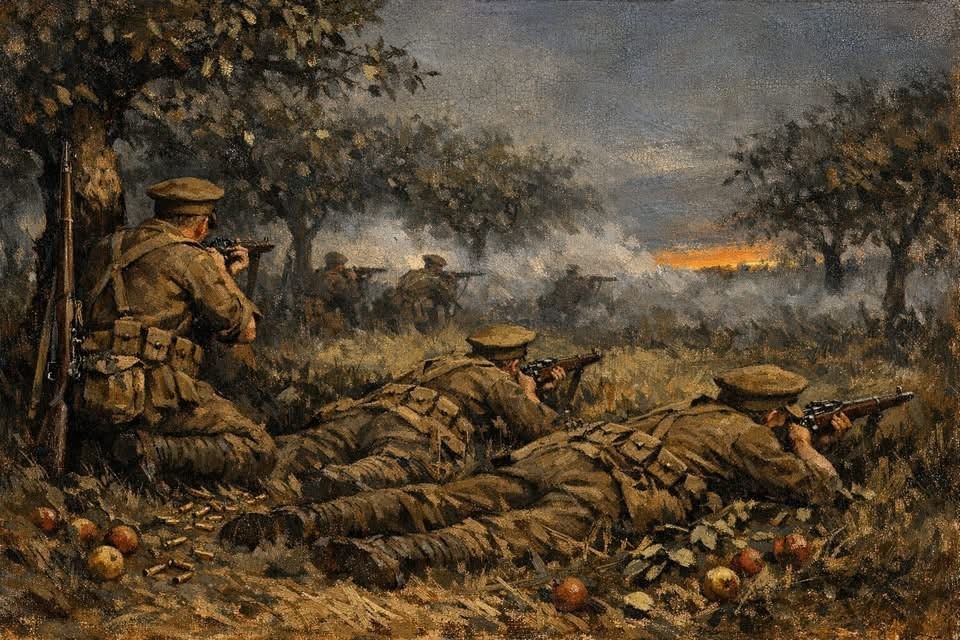
The stand of the 2nd Battalion, Royal Munster Fusiliers, at Étreux on 27 August 1914 is one of the most remarkable episodes of the opening weeks of the First World War. Taking place during the desperate British retreat from Mons, the action was not a conventional battle with clearly defined objectives and carefully prepared positions. Instead, it was a rearguard action fought by a relatively small force of Irish soldiers who were ordered to hold back the rapidly advancing German army and give the rest of the British Expeditionary Force time to escape. The Munsters’ resistance came at an enormous cost. By the end of the day, the battalion had been virtually destroyed as a fighting formation.
The 2nd Royal Munster Fusiliers were a regular army battalion, based at Aldershot when war broke out in August 1914. The outbreak of hostilities brought reservists rushing back to the colours, and the battalion was brought up to approximately 27 officers and 971 other ranks before leaving England on 13 August. Ten days later, the British Expeditionary Force fought its first major battle against the Germans at Mons in Belgium.
The battle of Mons was tactically successful in many respects, but the wider strategic situation rapidly deteriorated. The French armies were withdrawing, and the enormous German advance threatened to turn the British position. The BEF therefore began what became known as the Great Retreat. British soldiers marched southwards through Belgium and northern France, exhausted by heat, lack of sleep and the constant threat of German pursuit. The Munsters, having only recently arrived on the Continent, were soon caught up in this enormous withdrawal.
On 27 August, the 2nd Munsters were given the difficult task of covering the retreat. They were part of the 1st Division and had been serving in 1st (Guards) Brigade. Their orders required them to hold their position and delay the German advance, withdrawing only when ordered or when their position became untenable. The importance of their task was considerable: the British formations withdrawing to the south needed time to put distance between themselves and the German forces pursuing them.
The Munsters’ position lay in the countryside around Oisy and Étreux, close to the Sambre Canal. Two troops of the 15th Hussars were also involved in the operation. The countryside was quite different from the static trenches that would later become associated with the Western Front. Hedgerows, orchards, villages, roads and small fields provided both cover and obstacles, making movement difficult and creating opportunities for units to become isolated.
During the morning, German forces began pressing heavily against the British rearguard. The Munsters fought stubbornly, falling back as necessary while attempting to maintain cohesion. They eventually occupied positions nearer Étreux. The battalion’s companies became involved in fierce local fighting, with some units becoming separated as they attempted to carry out their orders through the maze of hedges and fields. The contemporary account of the action describes the violence of the fighting, with German attacks repeatedly meeting determined resistance from the Irish soldiers.
One of the most significant problems was that the Munsters became isolated. Orders for the wider British withdrawal were issued, but the battalion did not receive them. As neighbouring British units withdrew, the 2nd Munsters were left increasingly exposed. By the afternoon, German forces were moving around their flanks and cutting off their route of escape. What had begun as a deliberate rearguard action was becoming a fight for survival.
The Germans greatly outnumbered the isolated battalion. Contemporary accounts and later histories give somewhat different figures for the exact strength and casualties, but there is no doubt that the Munsters were confronted by overwhelming numbers. Captain H. S. Jervis, one of the surviving officers, later described the battalion as being attacked from three sides and facing odds estimated at between six and eight to one.
The fighting continued for hours. The Munsters repeatedly resisted German pressure, withdrawing towards an orchard near Étreux. Their ammunition was eventually exhausted. With their position surrounded and their ability to continue the fight gone, the surviving men were compelled to surrender. The action had lasted for approximately fourteen hours and had delayed the German advance, allowing other British formations to continue their withdrawal.
The casualties were catastrophic. Nine officers and 87 other ranks were killed according to one established regimental account, while many others were wounded or captured. Only a fraction of the battalion remained free after the action. Different sources give different totals for survivors, partly because men became separated during the fighting and some later rejoined their comrades. One account records four officers and 240 other ranks surviving to surrender, while other sources give different figures. What is certain is that the battalion had been devastated.
Among those killed was Major Philip Charrier, who had commanded the battalion during the action. Other officers were also killed or wounded, and the losses among the experienced leadership added to the tragedy. The National Army Museum records that the battalion suffered exceptionally heavy casualties at Étreux, with its officers suffering particularly severely.
The sacrifice of the Munsters did, however, achieve its immediate military purpose. Their prolonged resistance prevented the German advance from moving as quickly as it otherwise might have done. In the context of the Great Retreat, every hour mattered. The BEF was attempting to escape a vastly larger German force while remaining sufficiently intact to fight again. The Munsters’ stand bought precious time for the formations behind them.
There was also a striking human dimension to the episode. These were largely Irish soldiers serving in the British Army at a moment when Irish political life was deeply divided over the future of Ireland. Yet at Étreux they fought as a disciplined regular battalion under extraordinarily difficult circumstances. Their conduct became an important part of the regiment’s identity and reputation during and after the war.
The surrender at Étreux did not mean that the men who survived had escaped the war. Many became prisoners of war in Germany and endured years of captivity. Those who escaped capture or subsequently returned to the colours would see further fighting. The rebuilt 2nd Munsters later served on the Western Front and suffered heavily in subsequent battles.
The memory of Étreux remained particularly powerful within the regiment. A memorial was eventually erected in the orchard where the final stand took place, commemorating the men of the 2nd Royal Munster Fusiliers who died there. Their story became one of the regiment’s defining episodes: a battalion sent forward to delay an advancing enemy, isolated through the confusion of a rapidly changing battlefield, and ultimately surrounded after its ammunition had been exhausted.
The action at Étreux therefore deserves to be remembered not simply as a heroic last stand, but as a revealing example of the chaos and sacrifice of the first weeks of the First World War. The men of the 2nd Royal Munster Fusiliers had entered France only days before. Within a fortnight they had fought at Mons, endured the exhausting retreat and then been called upon to hold an isolated position against overwhelming German forces. Their resistance on 27 August 1914 came at a terrible price, but it fulfilled the essential purpose of a rearguard: to delay the enemy so that others could escape.
Étreux was one of the earliest tragedies suffered by the British Expeditionary Force on the Western Front. For the Royal Munster Fusiliers, however, it became something more enduring. The courage and sacrifice of the men who fought there became woven permanently into the regiment’s history. Their stand demonstrated both the determination of the pre-war regular army and the terrible human cost that would characterise the war for the next four years.
(Sources: Wikipedia. National Army Museum. The WFA. Iron News)