
Last Wednesday, I was treated regally by Matt Colley and his wife on my visit to Peterborough and surrounds. As we have said in Trench Lincs many times before, you do not need to visit France and Flanders to find Great War connections, many are on our doorsteps.
Heading firstly into the city centre, I was surprised by the amount of historic old buildings that still stand in Peterborough. One tends to think of it being a ‘new’ town similar to say, Milton Keynes. But it isn’t.
First stop on my personal guided tour, was an historic building adorned with a Blue Plaque, noting that it was the Great War recruiting office for Peterborough. Many men would have enlisted here for the local Northamptonshire regiment.

It was then on to the cathedral.
I had no idea that Katharine of Aragon, first wife of Henry VIII, was buried at Peterborough. Katharine, who was the daughter of the King and Queen of Spain, was a staunch Catholic and was originally married to Arthur, Henry VII’s eldest son, they were both just 15 years of age. When Arthur died prematurely, the second son Henry, married his brother’s widow to preserve the agreement between England and Spain.
There is no doubt that Henry and Katharine enjoyed a happy marriage, to start with, but their inability to produce a son and heir, led to Henry’s relationship with Anne Boleyn. With Anne pregnant, Henry needed to divorce Katharine but this was only possible with the blessing of the Pope in Rome, who refused the petition.
This left Henry with just the nuclear option, to cede from the Catholic church, and turn England towards Protestantism, as was happening in the Reformation across Europe at this time. By making himself Head of the Church of England, Henry was able to divorce Katharine who was reluctantly sent into exile where she eventually died at Kimbolton Castle in 1536.

Returning to the Great War, Edith Cavell, executed by the Germans in 1915 for aiding allied soldiers to escape, lived and worked in Peterborough prior to the war, and she has a large tablet erected in her memory.

The cathedral contains a military chapel,
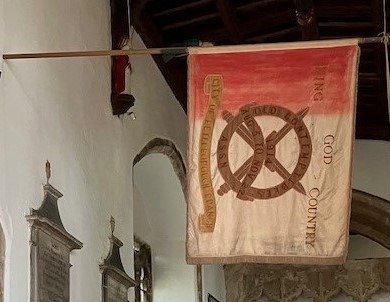
Many memorials are displayed here and nearby is a display of regimental colours that have been laid up over the years. One that caught my eye was this one for the 5th Battalion (Huntingdonshire) Northants Regiment, with all of their 14-18 Battle Honours displayed – Aisnes, Somme, Ypres, Arras.

Standing in the grounds of the cathedral is a large generic war memorial to all of the men and women who laid down their lives in all conflicts. It has the Laurence Binyon ‘They Shall Grow Not Old….’ Carved on one side and the Kohima Epitaph on the reverse.
Returning to the car, Matt conducted a tour of several villages of interest and first stop was just outside Connington, where stands on a major junction, a memorial to the USAAF Glatton air base. The only surviving structure from this air base is a large water tower that can be glimpsed amongst the trees.

Glatton was home to 748th, 749th, 750th and 751st Squadrons of the 457th Bombardment Group. From here, 237 combat missions were flown which saw the loss of 86 B-17’s and 739 air-crew.
Moving on, we headed to the picturesque village of Elton, where I was shown possibly a unique memorial. However, we started at the church yard where stands a traditional stone memorial adorned with a Celtic Cross. Interestingly, the names of the dead had been recorded chronologically and the place of death of each man had been recorded too.

Inside the church, Matt led me to a decorative Rood Screen which had been erected as a Roll of Honour, with everyman from the community who served, listed by year of enlistment. A truly special find, but the best was yet to come.

Directly opposite the church car park in Elton, there stands a wayside calvary. These are very common in France but I do not know of another one like this in England, although I am sure there will be other Great War calvary’s – if you know of one please let me know.
This, for me, was the find of the day and I do recommend that you take a run out to Elton to view it.

The final stop on Matt’s tour was to the village of Castor, which dates back to Roman times and where the church stands close to the site of a substantial Roman Villa. On the village green there stands a traditional war memorial which has had modern plaques installed in recent years. One plaque lists the names of the men from the community who fell in war, but the second plaque names all of the individual farms that the men came from during the 1914-18 war – a testament to the men of this agricultural community who made the supreme sacrifice.

We then enetered the church, St. Kyneburgha’s, where you can find a stone tablet on the wall as a another memorial to the men of Castor and the surrounding farms, note the three Jakes boys who all died in the war – what a blow that must have been to one family to lose three boys.

However, the highlight in this church, is that it was the home of the Peterborough branch of the Old Contemptibles from 1933 to 1972. When the branch closed, the standard was laid up in the church alongside their branch book of remembrance, which includes the name of Richard Charles ‘Shadder’ Sharpe VC, of the Lincolnshire Regiment who won his VC at Rouge Bancs in May 1915 – we have previously told his story in TL.

