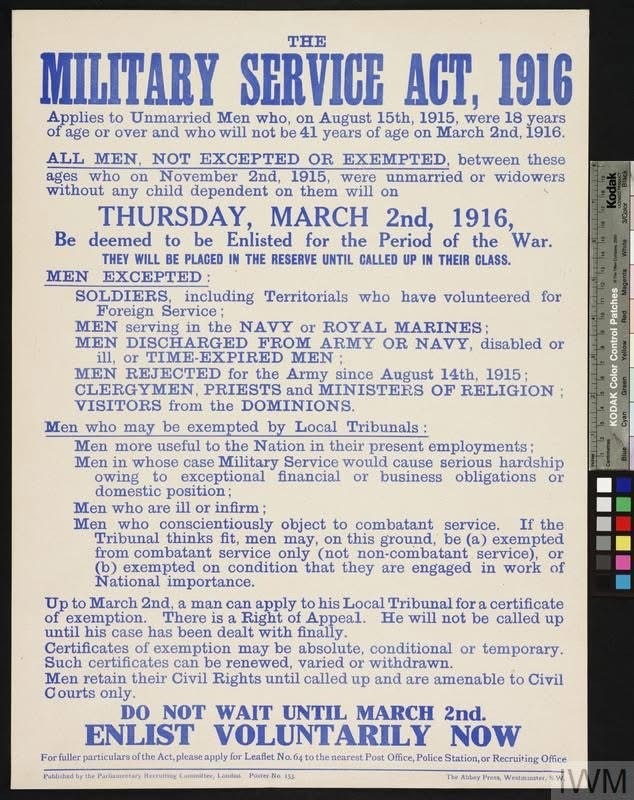
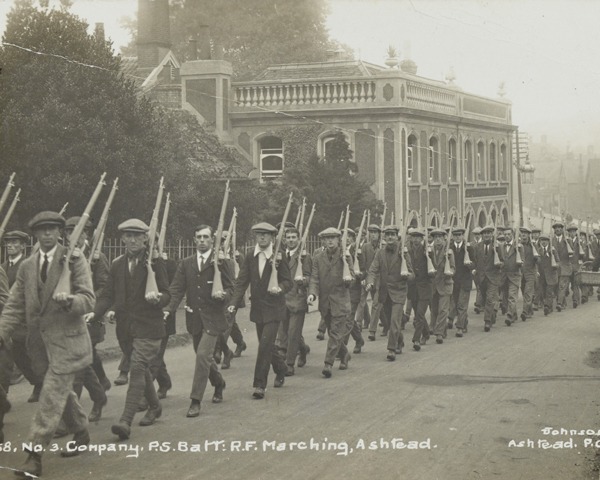
The Military Services Act came into being in January 1916 but it was March when the first men were officially called up for service, 110 years ago.
The introduction of conscription in the United Kingdom in 1916 marked a profound turning point in the nation’s conduct of the First World War. Until that moment, Britain had relied on a long-standing tradition of voluntary military service. The shift to compulsory enlistment under the Military Service Acts represented not only a military necessity but also a significant social and political transformation. It reflected the immense pressures of industrialised warfare and reshaped the relationship between the British state and its citizens.
When war broke out in August 1914, Britain entered the conflict with a relatively small professional army compared to the mass conscript forces of continental powers such as Germany and France. The British Expeditionary Force (BEF), though highly trained, was limited in size. Under the leadership of Secretary of State for War Lord Kitchener, a massive volunteer recruitment campaign was launched. Kitchener famously appealed for men to enlist for “the duration of the war,” and his image became iconic through the “Your Country Needs You” poster campaign. Initially, the response was overwhelming. By the end of 1914, hundreds of thousands of men had volunteered, motivated by patriotism, social pressure, economic incentives, and a widespread belief that the war would be short.

However, the optimism of 1914 quickly faded. The war on the Western Front became a brutal stalemate characterised by trench warfare, enormous casualties, and minimal territorial gains. Battles such as those at Ypres and Neuve Chapelle demonstrated the devastating human cost of modern industrial conflict. As the war dragged into 1915, voluntary recruitment began to decline sharply. Casualty lists lengthened, and the grim reality of life in the trenches deterred many potential recruits. Meanwhile, the demands of the war effort grew, requiring a steady flow of reinforcements.
The government initially attempted to address the recruitment crisis through moral pressure rather than compulsion. One notable initiative was the Derby Scheme, introduced in late 1915 by the Director-General of Recruiting, Lord Derby. Under this scheme, eligible men were asked to attest their willingness to serve when called upon. While it succeeded in registering many men, it failed to produce sufficient numbers for immediate deployment. By the end of 1915, it had become clear that voluntary enlistment could no longer sustain the army’s needs.
In January 1916, the government of Prime Minister H. H. Asquith introduced the first Military Service Act. Passed after intense parliamentary debate, it came into effect on 27 January 1916. The Act initially applied only to single men aged 18 to 41 in England, Scotland, and Wales (Ireland was excluded due to political sensitivities). Married men were temporarily exempted, reflecting both political compromise and social considerations. However, as the manpower crisis persisted, a second Military Service Act was passed in May 1916, extending conscription to married men within the same age range.
Although the Military Service Act had been passed in January 1916 and came into force on 27 January, March was when large numbers of single men were actually formally called up for military service. This included:
- Single men aged 18–41 who had not previously enlisted.
- Men who had “attested” under the Derby Scheme in late 1915 and were now mobilised according to their age groups.
- The continued functioning of local tribunals, which heard exemption appeals from men claiming essential work, medical unfitness, or conscientious objection.
March 1916 therefore marked the practical enforcement of compulsory service, rather than just its legal introduction. It was the point at which Britain began systematically drafting eligible single men into the army.
The introduction of conscription was controversial and marked a significant departure from Britain’s liberal traditions. Unlike many European states, Britain had no peacetime conscription system and prided itself on its voluntary army. Critics argued that compulsory service infringed upon individual liberty and contradicted the principles for which Britain claimed to be fighting. Supporters, however, contended that the scale of the war left no alternative. The need to match the vast conscript armies of Germany and France was seen as essential to national survival.
The legislation also included provisions for exemption. Local tribunals were established to hear applications from men seeking exemption on grounds such as ill health, essential civilian employment, or conscientious objection. The treatment of conscientious objectors became one of the most contentious aspects of conscription. Some objectors were assigned non-combatant roles, while others who refused any form of service faced imprisonment. Their experiences highlighted the tension between state authority and individual conscience in wartime Britain.
Conscription had far-reaching social consequences. It broadened the army’s social composition, drawing in men from diverse backgrounds, including those who might not have volunteered under normal circumstances. It also increased state involvement in managing labour and industry, as exemptions were often granted to workers in vital sectors such as coal mining, shipbuilding, and munitions. Thus, conscription was intertwined with the wider mobilisation of the British economy for total war.
Politically, the introduction of conscription contributed to the fall of Asquith’s government later in 1916. Dissatisfaction with the conduct of the war and divisions within the Liberal Party weakened his position, leading to his replacement by David Lloyd George in December 1916. Lloyd George would go on to oversee a more centralised and efficient war administration.
In conclusion, the introduction of conscription in 1916 represented a watershed in British history. It signified the transition from a limited, volunteer-based military tradition to the demands of total war. Driven by necessity rather than ideology, conscription reshaped British society, politics, and the relationship between citizen and state. Though controversial, it ensured that Britain could sustain its military commitments on the Western Front and continue the struggle until victory in 1918.