
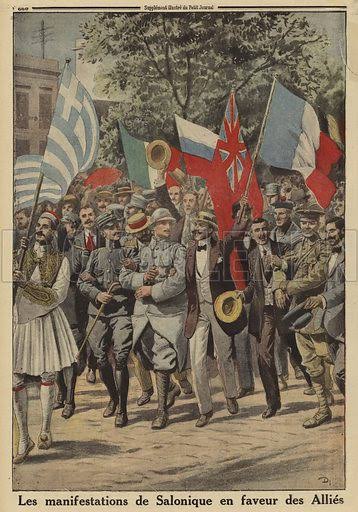
The Allied Note to Greece issued on 21 June 1916 was a significant diplomatic intervention during the First World War and represented a major step in the growing conflict between the Greek government and the Entente Powers. It highlighted the tensions created by Greece’s policy of neutrality and exposed the deep political divisions within the country, known as the National Schism. The note demonstrated the determination of Britain, France, and Russia to secure Greece’s cooperation and prevent the Central Powers from gaining influence in the eastern Mediterranean. Although presented as a diplomatic communication, the note was backed by military pressure and marked a turning point in Greek politics.
When the First World War broke out in 1914, Greece faced a difficult strategic situation. Prime Minister Eleftherios Venizelos believed that Greece should join the Entente Powers because he expected them to emerge victorious and believed participation would lead to territorial gains. In contrast, King Constantine I favoured neutrality. Educated in Germany and married to the sister of Kaiser Wilhelm II, the king was often viewed as sympathetic to Germany, although he argued that neutrality best protected Greek interests.
The disagreement between the king and Venizelos created a constitutional and political crisis. Venizelos resigned twice, while royal governments maintained a policy of neutrality despite increasing pressure from the Allies. The Entente Powers became frustrated because Greece occupied a strategically important position controlling access to the Balkans and the eastern Mediterranean. Allied troops had already landed at Salonika in 1915 to assist Serbia, making Greece’s neutrality increasingly difficult to sustain.
By 1916 the military situation in the Balkans had become more complicated. Bulgarian forces, allied with Germany and Austria-Hungary, threatened Allied positions and increased concerns that the Greek army might either cooperate with the Central Powers or fail to resist Bulgarian advances. Reports that Greek authorities had allowed Bulgarian occupation of strategic positions without resistance convinced the Allies that stronger action was necessary.
The Allied Note of 21 June 1916 was therefore issued jointly by Britain, France, and Russia. It demanded several measures designed to limit royal influence and ensure that Greece could not assist the Central Powers either directly or indirectly. Among its principal demands were the demobilisation of much of the Greek army, new elections under conditions considered fairer by the Allies, and changes in the administration that would reduce the influence of officials regarded as hostile to the Entente. The note also required greater cooperation with Allied military operations based in Salonika.
Although formally diplomatic, the note carried an unmistakable threat. Allied naval forces imposed pressure through a blockade and demonstrated their willingness to use military force if Greece refused to comply. This reflected the broader wartime trend in which diplomacy was increasingly backed by economic sanctions and military power. The Greek government understood that rejection of the Allied demands could lead to occupation of key territories or even open conflict with the Entente.
The reaction within Greece revealed the depth of the National Schism. Supporters of King Constantine viewed the note as an unacceptable violation of Greek sovereignty and an attempt by foreign powers to dictate domestic politics. They argued that Greece, as a neutral state, had every right to determine its own policies without external interference. Many royalists believed that the Allies were effectively forcing Greece into a war against its will.
Supporters of Venizelos interpreted the note differently. They believed that the royal government had failed to protect Greek interests by maintaining a neutrality that increasingly benefited the Central Powers. In their view, closer cooperation with the Entente offered the best opportunity to secure Greece’s future security and territorial ambitions. The Allied demands therefore reinforced the political arguments of the Venizelist movement and weakened the position of the monarchy.
The consequences of the note were considerable. Although the Greek government accepted several of the demands, the political crisis continued to deepen. Later in 1916 Venizelos established a rival Provisional Government of National Defence in Thessaloniki with Allied support, creating effectively two competing governments within Greece. One government remained loyal to King Constantine in Athens, while the other supported active participation in the war alongside the Entente.
The Allied intervention did not end with the June note. Continued pressure, including naval blockades and military occupation of strategic points, eventually forced King Constantine to leave Greece in June 1917. His son Alexander became king, while Venizelos returned to power. Greece then formally entered the First World War on the side of the Allies, contributing troops to the Macedonian Front and participating in the final offensives that helped defeat Bulgaria and weaken the Central Powers in the Balkans.
Historians have debated whether the Allied Note represented legitimate strategic necessity or an unjustified infringement of Greek independence. From the Allied perspective, the unstable political situation in Greece threatened military operations against Bulgaria and endangered the security of the Salonika front. Given the enormous stakes of the global conflict, Allied leaders believed they could not risk a potentially hostile or unreliable Greece.
From the Greek perspective, however, the note symbolised the vulnerability of smaller states caught between great powers during wartime. Greece’s sovereignty was compromised by external pressure, and its internal political divisions were intensified rather than resolved. The National Schism that emerged during these years had lasting effects on Greek politics and society, influencing political alignments for decades after the end of the First World War.
In conclusion, the Allied Note of 21 June 1916 was far more than a diplomatic communication. It was a decisive intervention in Greek domestic affairs that reflected the strategic priorities of the Entente Powers during the First World War. The note accelerated the National Schism, increased tensions between the monarchy and Venizelist movement, and paved the way for Greece’s eventual entry into the war on the Allied side. As such, it remains an important example of how international conflict can reshape the internal politics of a nation and demonstrates the powerful influence that great powers could exert over smaller states during one of history’s most destructive wars.