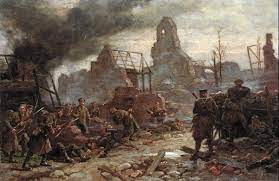
Here is a map of the disposition of British and Indian forces just prior to battle commencing. As you can see, it was a ‘pincer’ movement attack designed to pinch out the village and straighten the line, and it was the BEF’s first set piece offensive of the Great War without support from the French army.
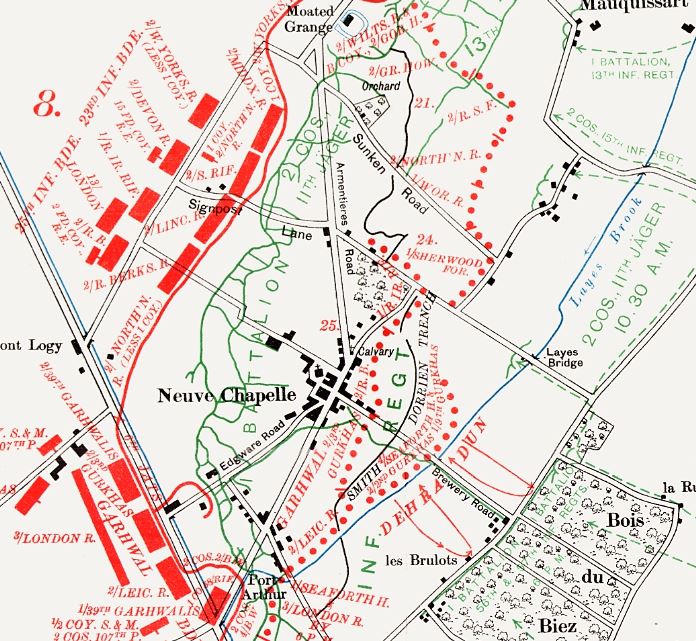
If you look to the centre left of the map, you can see that the 2nd Lincolns attacked to the right of SIGNPOST LANE, and immediately to their left, the neighbouring attacking battalion was the 2nd Scottish Rifles. The same battle and the same mode of attack made at exactly the same time, and yet both battalions had very different initial outcomes.
Using various sources, from written accounts, diary extracts and the Western Front Association’s resources, please find a compare and contrast article that I have put together.
The Battle of Neuve Chapelle (10–13 March 1915) was a major British offensive in the First World War aimed at breaking the German line in the Artois region of France. It was one of the first sustained, set-piece offensives by the British Expeditionary Force (BEF) and marked a shift toward coordinated artillery-infantry operations — with mixed results.
Although elements of the Indian Army and other British units were heavily involved, the 8th Division’s 23rd Brigade — including the 2nd Lincolns and 2nd Scottish Rifles — played a pivotal role in the central assault aiming to seize the initial German trench lines and advance on the village of Neuve Chapelle.
Order of Battle & Positioning
Both battalions were part of the 23rd Brigade, 8th Division under IV Corps (First Army):
- 2nd Lincolns — in the assaulting line alongside the 2nd Royal Berkshires tasked with clearing German trench systems and enabling follow-on units (notably the 1st Irish Rifles and 2nd Rifle Brigade) to push deeper.
- 2nd Scottish Rifles (Cameronians) — also in the initial assaulting wave but positioned where the German barbed wire was less effectively suppressed by artillery, creating a different tactical challenge.
Thus, although both experienced similar overarching objectives — to break into and through the German defences — their immediate tactical environments at the outset of the attack proved to be fundamentally different.
The Opening Assault: Artillery Preparation & Infantry Advance
The attack began at 08:05 on 10 March 1915, following a 35-minute artillery bombardment — the heaviest concentration of British artillery up to that point in the war.
This bombardment had mixed success:
- It created gaps in the German barbed wire along much of the front, facilitating infantry advance.
- However, in some sectors, including where the 2nd Scottish Rifles were positioned, wire remained largely uncut due to terrain and coverage issues. A battery of 4.5” Howitzers detailed to support the Scottish Rifles, did not arrive on time and so failed to fire on the German trench line immediately opposite the Scottish Rifles.
2nd Lincolns: A Successful Initial Advance
The 2nd Lincolns’ war diary records a bold and coordinated advance:
- Infantry went over the parapet immediately after the barrage lifted.
- After cutting the German wire quickly, they seized the first German trench with relatively low losses – less than 20 men.
- They pushed on down the German trench line, dispersing defenders with grenades and closing quickly on the second line. This is where the majority of casualties occurred.
This assault behaviour — maintaining momentum after crossing no-man’s-land and aggressively clearing successive trench lines — was emblematic of early BEF offensive doctrine at Neuve Chapelle.
Nevertheless, the advance was not without human cost:
- Lieutenant-Colonel George McAndrew, the commanding officer of the Lincolns, was killed between the first and second German trenches by friendly artillery shell fragments.
- The battalion’s second-in-command was killed the following day.
- In total, 111 officers and men were killed or died of wounds in the battalion during the battle. Including Cecil Peake, as noted in Trench Lincs last week – killed by a German officer who surrendered, and then pulled out his pistol and shot Peake at close range.
This highlights the brutal reality of even a tactically successful assault: momentum did not stop casualties, and losses among battalion leadership fell heavily.
2nd Scottish Rifles: A More Ferocious Struggle
In contrast, the 2nd Scottish Rifles’ experience was characterised by heavier German resistance and failed wire suppression:
- The uncut barbed wire in front of their position turned no-man’s-land into a lethal killing zone during their advance.
- German machine guns and rifle fire exacted an especially cruel toll on the battalion’s officers.
- Lieutenant-Colonel Wilfred Bliss, the commanding officer, was killed early in the assault, alongside a catastrophic loss of other officers.
- Accounts from regimental histories and war diarists describe the attack as one of the hardest-fought and costliest within the brigade. Despite this, survivors of the Scottish Rifles showed tenacity.
- Under the remaining junior officers, the unit managed to push through or around strong points, even engaging in close-quarters trench combat.
- Captain Ferrers and Lieutenant Bibby are recorded as rallying elements of the battalion and forcing their way into trenches despite horrific casualties.
In sheer numbers, the Scottish Rifles suffered more:
- Nearly 200 officers and other ranks were killed, with a disproportionate number among the officer cadre.
- Multiple officers were buried side by side at Brown’s Road Military Cemetery, underscoring the ferocity of enemy fire faced by the battalion’s leadership and assault elements.
Comparison of Tactical Outcomes
| Aspect | 2nd Lincolns | 2nd Scottish Rifles |
| Role in assault | Central assault, cleared first German trenches and supported follow-on attack | Central assault, on sector with largely untouched wire |
| Wire obstacle effect | Wire largely neutralised, advance more cohesive | Wire largely uncut, severely restricting movement |
| Initial contact | First trench seized with relatively few casualties | Contact with intact defences, heavy casualties |
| Leadership losses | CO killed mid-assault; second-in-command soon after | CO and most officers killed or incapacitated early |
| Infantry progression | Progressed into and through German trench systems | Struggled more to breach defences; close-quarters fighting |
| Total known fatal losses | 111 KIA or died of wounds | Nearly 200 killed; 450 more wounded |
This comparison shows that, although both battalions were involved in the same offensive, their battlefield experiences diverged sharply due to:
- Differences in terrain and obstacles encountered (cut versus uncut wire).
- Variation in initial German defensive strength and positioning.
- The impact of losses among leadership on unit cohesion and morale.
The Human Dimension: Leadership, Training, Morale
The devastating losses among officers in both battalions raise significant questions about command and control during early BEF offensives:
Effect of Officer Casualties
For both battalions, the loss of commanding officers had immediate repercussions:
- With officers killed or wounded, junior NCOs and lieutenants were often forced to assume command while under fire, testing the depth of training and morale within the units.
- Despite this, both battalions demonstrated remarkable resilience, with surviving leaders rallying men and pushing on with assigned tasks.
Training & Regimental Culture
The Cameronians had a long tradition of marksmanship and co-ordinated platoon action, and some historians note that extended pre-war regimental training contributed to strong trust and cohesion among men under fire.
In contrast, the Lincolns, a county regiment with less storied battlefield experience before 1915, still performed their tasks with discipline, suggesting that standard BEF training effectively prepared units for coordinated offensive action when supported by artillery preparation.
Aftermath: Consolidation and Strategic Impact
By 12 March, the overall battle had bogged down despite initial British success. Communications problems, ammunition shortages, and German reinforcements stalled further exploitation beyond Neuve-Chapelle itself.
Both battalions stayed in the line during the consolidation phase:
- They helped defend positions against German counter-attacks.
- They provided manpower for the hard work of entrenching and fortification in newly captured ground.
The broader offensive ultimately failed to achieve its strategic breakthrough, but it demonstrated the potential — and the severe risks — of coordinated infantry-artillery attacks for the BEF. This was not the only time that the BEF found that they could break in, but not break through the German trench lines.
Conclusion: Shared Sacrifice, Different Experiences
The experiences of the 2nd Lincolns and the 2nd Scottish Rifles at Neuve Chapelle illustrate the complex and mutable nature of First World War combat:
- Both units displayed courage and discipline under fire.
- Both were exposed to intense artillery and machine-gun fire.
- Yet the nature of the obstacles they faced, the initial tactical environment, and the balance of casualties among leadership produced distinct battalion narratives within the same battle.
- The Lincolns’ relatively smoother advance into German trenches — and their ability to sustain operational momentum despite losses — contrasts with the Scottish Rifles’ struggle against intact wire and lethal defensive fire. These differences underscore how small variations in battlefield conditions could produce vastly different soldiering experiences, even within the same brigade.
Together, their stories reflect not only the horrors of early trench warfare but also the adaptability and tenacity of British infantry in 1915 — grim foreshadowing of the attritional combat that would dominate the Western Front for years to come.
The outcome of the opening of the battle as detailed above, gives an account of each battalion’s experience, but, what did the survivors have to say?
2nd Lincolns: Progress and Determination.
The 2nd Lincolns advanced in a sector where the preliminary bombardment had largely succeeded in cutting the German wire. Several surviving accounts suggest that the battalion crossed no-man’s-land with a sense of grim anticipation rather than immediate chaos.
One private soldier later recalled that when the whistles blew at 8:05 a.m., “the smoke from our shells hung low and grey, and we went through it as if stepping into fog.” The artillery barrage had stunned many German defenders in the forward trench. According to regimental recollections, the first trench was entered with surprisingly little resistance — a jarring contrast to the weeks of expectation that any attack would be suicidal.
Yet this relative tactical success did not insulate the battalion from trauma. A frequently cited detail in regimental memory is the death of their commanding officer, Lieutenant-Colonel George McAndrew, killed by shellfire as the battalion pressed beyond the first German trench. One officer wrote afterward that the men “had hardly realised we were in the second line before word came down that the Colonel was hit.” The shock of losing a respected commander during what appeared to be a victorious advance had a profound emotional impact.
Letters from Lincolnshire soldiers after the battle frequently juxtapose pride and grief. One corporal described the day as “a grand show for the regiment, though dearly paid for.” The phrase captures the battalion’s paradoxical experience: operational achievement paired with heavy loss.
There is also evidence in personal testimony of disorientation once the initial trenches were taken. The battlefield around Neuve Chapelle quickly became a maze of smashed parapets and cratered communication trenches. One junior officer wrote that “maps were useless, and the trenches twisted like rabbit runs.” While the Lincolns managed to maintain forward momentum early on, they too experienced confusion when advancing beyond their immediate objective. This reflects a broader problem at Neuve Chapelle: success outrunning command-and-control systems.
The 2nd Scottish Rifles: Wire, Fire, and Catastrophe
In contrast, testimony from the 2nd Scottish Rifles reveals a far more desperate opening phase. Positioned where the artillery had failed to cut the barbed wire effectively, the battalion encountered intact entanglements and intense German machine-gun fire almost immediately upon leaving their trenches.
A surviving account from a private in the battalion describes men “climbing and hacking at the wire while bullets struck sparks from it.” This image — soldiers trapped against uncut wire — recurs in multiple regimental histories. It was a nightmare scenario for any assaulting infantry: immobilised in open ground under direct fire.
The loss of Lieutenant-Colonel Wilfred Bliss and a large proportion of the officer corps early in the attack compounded the chaos. One NCO later remembered that “officers seemed to fall all round us,” leaving sergeants to rally fragmented groups of men. In some platoons, command devolved within minutes of the advance beginning.
Yet even amid devastation, there were examples of determined initiative. Accounts speak of small parties forcing their way through gaps or crawling along the flank to enter the German trench from less defended angles. One lieutenant reportedly gathered fewer than twenty men and charged a machine-gun position that had been enfilading the battalion’s line, silencing it in close combat. Such actions did not eliminate the heavy casualties, but they prevented total collapse.
The emotional tone in Scottish Rifles letters is notably different from that of the Lincolns. Where Lincolns’ correspondence often blends pride with sorrow, Cameronians’ accounts frequently emphasise shock at the scale of loss. One soldier wrote home that “our company is but a shadow,” a stark expression of the attrition suffered in a single morning.
Shared Themes: Fear, Discipline, and Adaptation
Despite their differing tactical situations, testimony from both battalion’s reveals shared emotional and psychological themes.
1. The Artillery’s Ambiguous Role
Both sets of accounts comment on the overwhelming noise and smoke of the preliminary bombardment. Soldiers described the ground shaking and the air thick with dust. For some Lincolns, the barrage provided confidence that German defences had been shattered. For many Scottish Rifles, the discovery that wire remained intact created a bitter sense of betrayal — not directed at their own artillerymen, but at the unpredictability of modern firepower.
One Scottish Rifles private noted, “We had been told the wire was gone. It was not.” That short sentence encapsulates the gulf between expectation and battlefield reality.
2. The Collapse and Reinvention of Leadership
The death of commanding officers in both battalions forced rapid adaptation. In the Lincolns, despite losing their CO, enough of the officer structure remained to preserve cohesion. In the Scottish Rifles, officer casualties were so severe that NCO leadership became critical almost immediately.
Personal recollections often praise the steadiness of sergeants and corporals. A Lincolnshire sergeant wrote that “the lads kept their dressing as on parade,” an echo of pre-war drill discipline under extreme conditions. Similarly, a Cameronians’ lance-corporal recalled that men “looked to the stripes when the stars were gone,” a poignant description of rank insignia assuming symbolic importance when officers fell.
- Close-Quarters Combat
Once inside German trenches, both battalions experienced brutal hand-to-hand fighting. Testimonies mention grenades, bayonets, and revolvers. The Lincolns described bombing down trenches methodically, clearing dugouts one by one. The Scottish Rifles, when they managed to penetrate the wire, recounted chaotic melees in narrow trench corridors.
One Cameronian wrote after the war that “it was not battle as imagined, but murder in a ditch.” The rawness of this phrasing conveys how alien trench fighting felt compared to pre-war conceptions of open manoeuvre warfare.
Memory and Regimental Identity
Post-war commemorative accounts also reveal differences in how each battalion integrated Neuve Chapelle into its regimental identity.
For the Lincolns, the battle was remembered as a hard-won success marred by grievous officer losses. Regimental histories often frame the action as proof of the battalion’s professionalism and offensive spirit.
For the Cameronians, Neuve Chapelle became a touchstone of sacrifice. The clustering of graves of Scottish Rifles officers in military cemeteries near the battlefield reinforced the sense of collective martyrdom within the regiment’s memory. Veterans’ reunions frequently invoked the fallen of March 1915 as emblematic of the regiment’s endurance.
Yet in both cases, letters reveal ordinary soldiers framing the experience in more personal terms: the loss of friends, the exhaustion after days without proper rest, and the strange quiet that followed the initial assault.
The Aftermath in Personal Perspective
After the first day’s fighting, both battalions endured the exhausting work of consolidation. Diaries describe digging in on captured ground under intermittent shellfire. One Lincoln wrote that the excitement of the charge gave way to “a weariness like lead.” A Cameronian described lying in a shallow scrape, “too tired even to think,” while shells burst nearby.
Food and water shortages are common themes in both battalions’ recollections. Communication breakdowns left forward troops uncertain of wider developments. Many soldiers only learned days later that the hoped-for breakthrough had stalled.
There is also evidence of early war optimism fading. Some Lincolns wrote confidently that Neuve Chapelle showed the Germans could be beaten. By contrast, several Scottish Rifles accounts express a more sobering conclusion: that even success came at fearful cost.
Conclusion: Lived Experience Within the Same Battle
Personal testimonies illuminate how two battalions fighting within the same brigade at the Battle of Neuve Chapelle could experience profoundly different emotional and tactical realities.
For the 2nd Lincolns, the day was marked by initial momentum, operational accomplishment, and the devastating loss of senior leadership amid success. Their accounts often blend pride with grief.
For the 2nd Scottish Rifles, the assault began in near-catastrophe against uncut wire and murderous fire, producing a tone of shock and sacrifice that shaped regimental memory thereafter.
Yet beneath these contrasts lie shared threads: courage under fire, rapid adaptation when leaders fell, the confusion of trench fighting, and the exhaustion of consolidation. The soldiers’ own words — whether measured, bitter, or quietly proud — reveal Neuve Chapelle not as a single unified experience, but as a mosaic of intensely local and deeply human stories.