In the annals of Anglo-Singaporean history, no date is more infamous than February 15th 1942. On this day, having lost control of the island’s fresh water supplies, General Percival surrendered all British and Allied forces in Singapore to the Japanese.
However, did you know that on the same date, 15th February, twenty-seven years in earlier in 1915, Singapore once again leapt to the forefront of British history, when Muslim soldiers of the British Indian Army mutinied.
The Singapore Mutiny of February 1915 was one of the most serious military uprisings faced by the British Indian Army during the First World War. Taking place in the strategically vital British colony of Singapore, the mutiny exposed vulnerabilities within imperial strategic thinking and reflected the wider global tensions stirred by the war.

At the heart of the uprising was the 5th Light Infantry, a regiment composed largely of Muslim Rajputs and Pathans from northern India. In early 1915, the British Empire was deeply engaged in the First World War, fighting against the Central Powers, including the Ottoman Empire. Because the Ottoman Sultan was widely regarded as Caliph by many Sunni Muslims, British authorities worried about the loyalty of Muslim soldiers serving in their forces. These anxieties proved significant in Singapore.
Rumours circulated among the Sepoys that they were about to be deployed to fight fellow Muslims in the Middle East. At the same time, anti-British propaganda spread by Indian nationalists and agents linked to the Ghadar Party encouraged rebellion within Indian units across the empire. Poor leadership within the regiment, communication failures, and mistrust between British officers and Indian troops further heightened tensions.
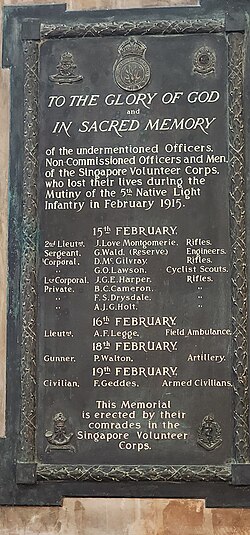
The mutiny began on 15th February 1915, when Sepoys of the 5th Light Infantry turned on their officers. Several British officers were killed in the initial outbreak. The rebels then spread out across Singapore, attacking European civilians and freeing German prisoners of war who were being held on the island.
The background to the mutiny starts with the removal of British troops to the Western Front which left solely Indian troops in Singapore.
In October 1914 the all-Muslim 5th LI (comprised of Rajput Ranghars and Pathans) had been dispatched to Singapore to replace the 1st Battalion King’s Own Yorkshire Light Infantry, which was rushed off to the BEF. The 5th LI was not combat ready; morale was low, communications poor, and leadership lacking. The commanding officer, Lt. Col. E. V. Martin, had been recently promoted from within the regiment, an unpopular choice even with the British officers.
Orders came for the 5th LI to leave Singapore for Hong Kong on 16 February. So little was Martin trusted that rumours flew that the 5th LI was going to be sent to the Middle East to fight against Muslims, contrary to the Fatwa of Mehmet V.
The 5th LI was guarding the 309 prisoners from the SMS Emden and other interned Germans, and one named Lauterbach, a reserve Oberleutnant who spoke Urdu, allegedly encouraged the troops to mutiny, promising German cooperation.
By plan the mutiny started around 3:30 P.M. on the 15th. The four Rajput companies of the 5th LI plus about 100 men from the Malay States Guides Mule Battery swarmed out, killing the two British duty officers. The mostly Pathans of the remaining four companies refused to participate and hid.
The mutineers divided into groups. One was sent to obtain more ordnance from the Tanglin Barracks magazines, another to kill Lt. Col. Martin and other officers at their residences and the last to release the Germans, held at Alexandra Barracks. There the Sepoys killed ten British soldiers, three Sultanate troops, and one German. Three British soldiers and one German were wounded but survived, as did the eight RAMC personnel in the hospital, one of whom managed to escape under heavy fire to raise the alarm. The Sepoys expected the Germans to join them, but they declined, even refusing to accept rifles. About 35 Germans did choose to leave the compound, contemplating escape.
Moving through the city the mutineers killed a number of Chinese civilians at Keppel Harbour and Pasir Panjang, while a large force attacked Lieutenant-Colonel Martin’s bungalow. Fortunately for Martin and the three men with him at the time a detachment of eighty men of the Malay States Volunteer Rifles had been training nearby, and they joined in the defence of the bungalow. The siege lasted through the night, but when morning came the defenders were still there, and already the mutiny was almost over.
Meanwhile, more officers had been killed, although not Martin, who attempted to rally the Pathans but failed. The Tanglin Barracks occupied 210 acres and was too big for the mutineers to fortify, so the Sepoys roamed the streets, targeting civilians randomly. But without strong leadership and without German assistance, the mutiny never had a chance of success.
Since it was the middle of the Chinese New Year, the majority of the Chinese in the Singapore Volunteer Corps were unavailable, but a scratch force of British garrison personnel, Royal Marines from HMS Cadmus and some Sultanate soldiers fought desperate little running skirmishes with the mutineers throughout the 15th and 16th . On the 17th 158 Japanese marines, plus French and Russian sailors, came ashore and promptly defeated the largest group of the Sepoys in a sharp battle after which many surrendered and the rest dispersed into hiding.
On the 20th the 1st/4th King’s Shropshire Light Infantry arrived from Burma and cleared the pockets of resistance. By the night of 22 February all was secure.
A Court of Inquiry was convened on 23 February, first held in secret but later publicly, which concluded on 15 May, resulting in 47 death sentences, 184 prison sentences and several transportations. Public executions were conducted at Outram Prison, witnessed by a crowd estimated at 15,000.

Public execution of 47 mutineers.
Casualty lists vary, but at least 40 loyal soldiers and as many as 18 civilians died. Mutineer casualties are not known.
Lt. Col. Martin, despite the defence of his bungalow, was heavily criticised by the subsequent Court of Inquiry, and retired. The only action he saw in the Great War was the defence of his own house against his own men. The remnant of the 5th LI was sent to Africa, then to Aden and served credibly. Nevertheless, it was disbanded in 1922.
After the Singapore Mutiny the British were unwilling to garrison colonies exclusively with Indian units, which placed a further strain on their manpower. All Indians residing in Singapore were required to register, causing ill feelings among a mostly loyal community. In order to enhance Singapore’s internal security, the British passed the “Reserve Force and Civil Guard Ordinance” in August 1915, requiring compulsory military service from all male subjects between 15 and 55 years of age who were not already serving in the armed forces, volunteers, or police.
The Singapore Mutiny had significant implications. Though limited in scale compared to later anti-colonial movements, it revealed cracks in the structure of imperial rule during wartime. It also highlighted the influences of global politics: events in Europe and the Middle East reverberated in Southeast Asia, influencing soldiers thousands of miles from the main battlefronts.
In the longer term, the mutiny became part of the broader narrative of resistance within colonial armies. While British accounts often portrayed the event as a breakdown of discipline fuelled by rumour and external agitation, later historians have emphasized the complex mixture of religious solidarity, nationalist sentiment, and local grievances that contributed to the revolt.
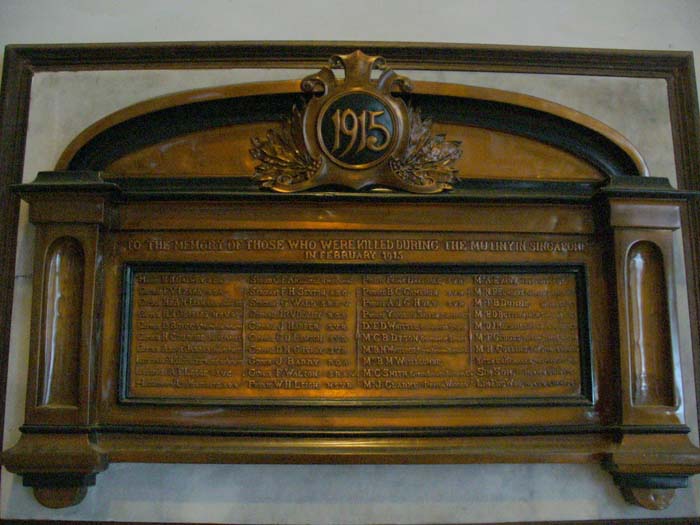
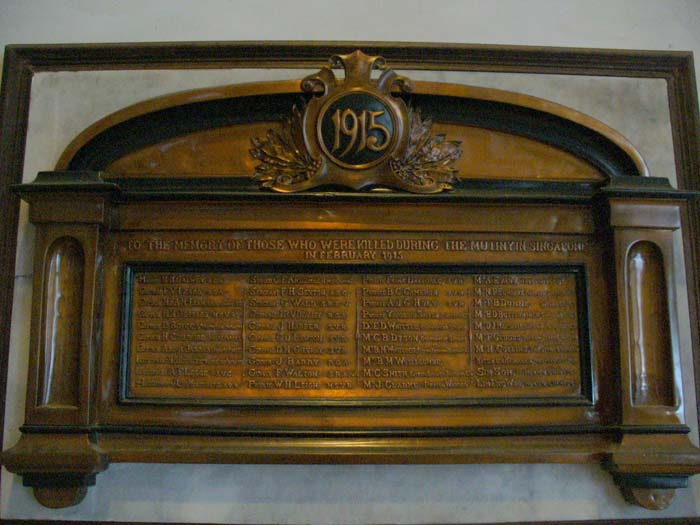
Memorial to the men killed in the uprising.