Monday morning saw an early start for what proved to be an easy drive down to Portsmouth for a 3pm six-hour sailing across to Ouistreham/Caen. On arrival, Monday’s itinerary was completed with a drive to our chosen hotel on the northern side of Caen, giving easy access the next morning to the road to St. Mere Eglise.
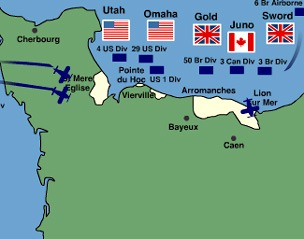
Tuesday dawned bright and sunny and after a coffee and croissant breakfast, we set off on the N13 for the 50-mile drive to the furthest point west of the Operation Overlord landing beaches, St. Mere Eglise and Utah beach.
Arriving in the main square at St. Mere Eglise, we met up with the rest of our party from the UK and Philip and Nadine, who made the journey from Ronse, Belgium. We now had a party of ten in a three car convoy.
Standing in the square, we discussed the operational requirement to hold the flanks of the landing beaches, and at the west (American) end of the action, this was achieved by the dropping of some 13,000 paratroopers from the 82nd and 101st Airborne Divisions in the early hours of 6th June 1944.
The parachute drop was not straightforward and men were scattered across the DZ and the Cotentin Peninsular in general. On landing, small pockets of men joined up and proceeded to their chosen targets. The town of St. Mere Eglise was liberated after a fierce fight and the soldiers dug in to repel the inevitable counter attacks.
The first seaborne landings were expected from 6.30am and it was also necessary to secure the four hard causeway roads leading inland from Utah beach across the marshy ground, much of it deliberately flooded by the Germans.
Taking to the cars, we drove to the Azeville battery, a substantial four casemate concrete battery that was capable of firing onto the landing beach and which, like the nearby Crispbecq battery, was part of Hitler’s Atlantic Wall. There is a small museum on site and Azeville is well worth a visit to learn how these batteries were attacked and neutralised by determined American troops.
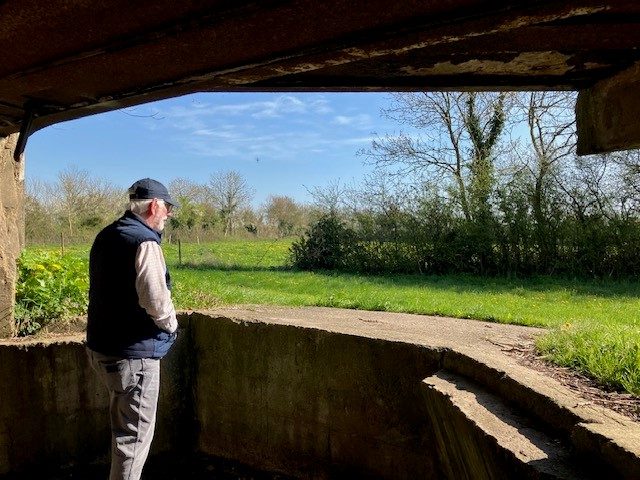
View from a casemate at Azeville battery.
Next stop was Utah beach itself. Here we stopped three times, on the western and eastern flanks and in the centre of the landing area. There are a number of good memorials and museums to visit as well as a café bar with toilet facilities.
After a discussion about the events of the landings on 6th June, which were successful without heavy casualties for the US 4th Division, we stopped for a welcome drink, before continuing inland to look at how the infantry linked up with the resisting paratroopers and a defensive initial beachhead was formed.
The early 2000’s television series, Band of Brothers, which featured the true life exploits of Easy Company, 506th Parachute Infantry Regiment, 101st Division made household names of the surviving veterans, especially the Company Commander, Major Richard (Dick) Winters, and today, he is remembered with his own memorial statue, together with the Band of Brothers Memorial at Brecourt Manoir, which remembers those men of the company lost in the fighting at Brecourt.
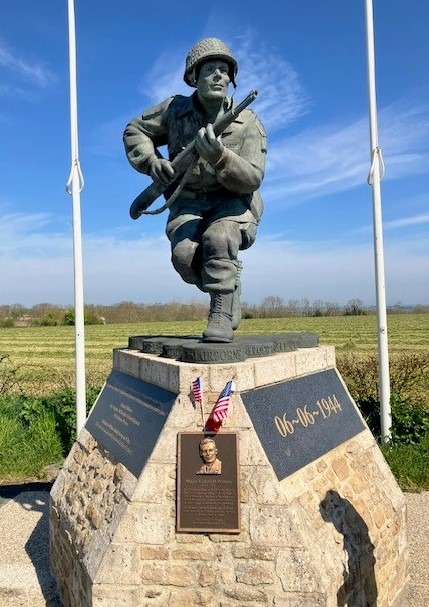
This firefight was a text book advance by determined raiders which captured another major German battery that could have wreaked havoc by firing onto the landing beaches. The attack by Winters’ men is reputedly still taught at Westpoint Academy to this dayTaking to the cars once again, we headed for the Pointe du Hoc, scene of the famous landing by US Rangers led by Colonel Rudder. The German battery at Pointe du Hoc was sited midway between Utah and Omaha beaches and could have caused untold damage to the landing troops.
Unlike the beach landings, Pointe du Hoc was sited on cliff tops, some 90 feet above the small landing area, and here, under fire, the Rangers scaled the cliffs on ropes, over came the German defenders and then discovered, that due to continual air force bombing raids, the Germans had removed the guns from their casemates and moved them half a mile inland.
Pushing cautiously inland, the Rangers located the guns camouflaged in an orchard and after a sharp firefight, they were able to destroy the guns with thermite grenades, before digging in and holding their perimeter until relieved by troops arriving from Omaha beach on 8th and 9th June.
Omaha beach was our next stop. Here the attacking Americans, many of them National Guardsmen, suffered some 4,000 casualties in the initial landing, and this is the scene so graphically portrayed in the film, Saving Private Ryan.
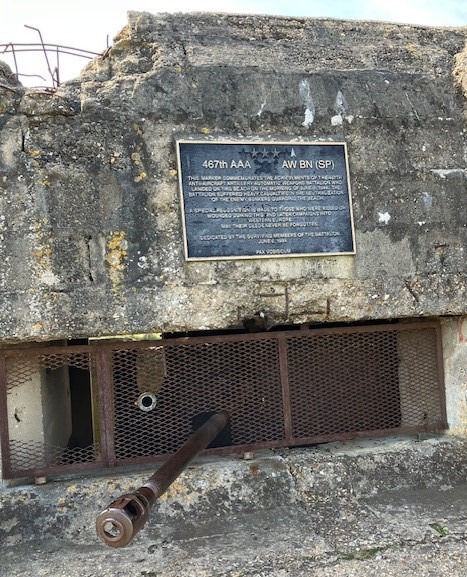
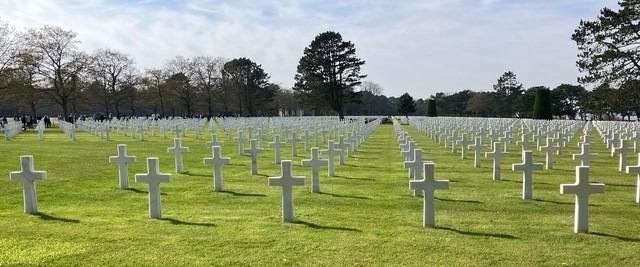
The day was completed by a pilgrimage to the huge US Cemetery at Colleville Sur Mer About Normandy American Cemetery – American Battle Monuments Commission (ABMC)
Followed by a visit to the British CWGC cemetery at Bayeux. Bayeux War Cemetery | Cemetery Details | CWGC
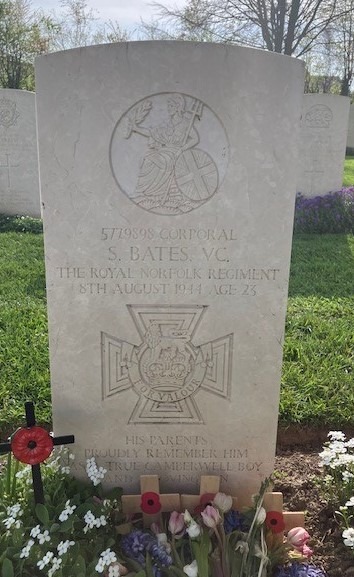
The CWGC cemetery at Bayeux is the last resting place of Sidney Bates VC. Sidney Bates won his VC on 6th August 1944 but died of his wounds received on the 8th. Bates’ actions and his VC citation read like something from a boys own comic book.
BATES, Sidney – Corporal, Royal Norfolk Regiment – 6th August 1944. “In North-West Europe on 6th August, 1944, the position held by a battalion of the Royal Norfolk Regiment near Sourdeval was attacked in strength by 10th SS Panzer Division.
“The attack started with a heavy and accurate artillery and mortar programme on the position which the enemy had, by this time, pin-pointed. Half an hour later the main attack developed and heavy machine-gun and mortar fire was concentrated on the point of junction of the two forward companies.
“Corporal Bates was commanding the right forward section of the left forward company which suffered some casualties, so he decided to move the remnants of his section to an alternative position whence he appreciated he could better counter the enemy thrust.
“However, the enemy wedge grew still deeper, until there were about 50 to 60 Germans, supported by machine guns and mortars, in the area occupied by the section.
“Seeing that the situation was becoming desperate, Corporal Bates then seized a light machine-gun and charged the enemy, moving forward through a hail of bullets and splinters and firing the gun from his hip.
“He was almost immediately wounded by machine-gun fire and fell to the ground, but recovered himself quickly, got up and continued advancing towards the enemy, spraying bullets from his gun as he went.
“His action by now was having an effect on the enemy riflemen and machine gunners but mortar bombs continued to fall all around him.
“He was then hit for the second time and much more seriously and painfully wounded. However, undaunted, he staggered once more to his feet and continued towards the enemy who were now seemingly nonplussed by their inability to check him.
“His constant firing continued until the enemy started to withdraw before him. At this moment, he was hit for the third time by mortar bomb splinters, a wound that was to prove mortal.
“He again fell to the ground but continued to fire his weapon until his strength failed him. This was not, however, until the enemy had withdrawn and the situation in this locality had been restored.
“Corporal Bates died shortly afterwards of the wounds he had received, but, by his supreme gallantry and self-sacrifice he had personally restored what had been a critical situation.”
Sidney Bates: Hero who charged enemy head-on with a machine gun, earning him Victoria Cross
A convivial dinner in Bayeux was enjoyed by all, and after saying au revoir to Nadine and Philip, we headed back to our base in Caen.
Wednesday saw a continuation of the fine weather as we headed to Pegasus Bridge to discuss the British airborne and paratrooper actions to secure the eastern flank against German retaliation.
Three gliders landed silently at the foot of the bridge in the early hours of 6th June and the disembarking men of the Ox and Bucks Light Infantry captured the bridge against unsuspecting opponents after a brief firefight. Unfortunately, Lieutenant Den Brotheridge was killed in this action, and probably became the first British soldier killed by direct enemy action on D-Day.
The famous Café Gondree was closed but we would pay a return visit later in the week. The party then headed for the Pegasus Bridge museum before heading to Ranville war cemetery to pay our respects to Lieutenant Brotheridge and many of his comrades killed in the following days.

Next stop was the Merville Battery the scene of a dramatic assault by men of the 9th Battalion Parachute Regiment. The troops were scattered across a wide area and only some 150 men from a drop of nearly 700 made the muster point.
Nevertheless, it was imperative that the Merville battery was silenced and the attack went in as planned. The men of 9/Para suffered 50% casualties but their attack was successful and although a later counter attack recaptured the battery, the guns had been damaged beyond effective use.
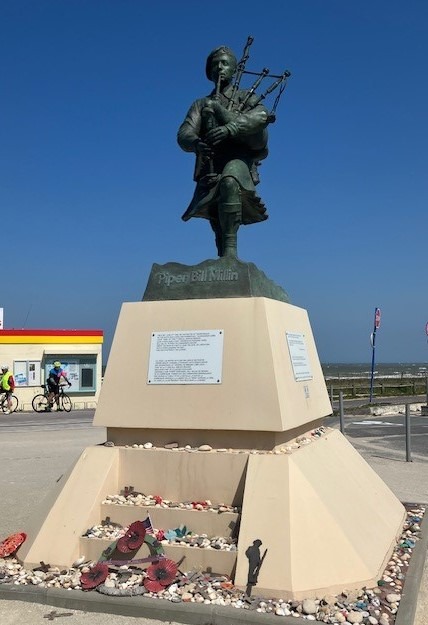
We then drove to Riva Bella Plage at Ouistreham, the eastern flank of Sword beach and the site of the landing by Lord Lovat’s Commando Brigade. It was here that Lord Lovat waded ashore piped by his personal piper, Bill Millin.
After overcoming stiff resistance on the beach, especially from the fortified casino, the commandos made their way inland to relieve the men of the Ox and Bucks LI who were still holding out at Pegasus Bridge.
After a tour along the length of Sword beach, we reached the site of the Canadian landings at Juno beach, and our final stop of the day was at the magnificent Canadian museum, the Juno Beach Centre Juno Beach Centre.
Wednesday evening was always destined to be a pub night as first time tourist, Steve Eley (my son in law) is a devoted Aston Villa supporter and they were playing Paris St Germain in the Champions League. The food and beer were better than the result, as Villa lost 3-1!
After two days of sunshine, Thursday dawned cloudy, cold and overcast as we met up at the German battery at Longues Sur Mer. Here the original guns can still be seen in the casemates, and the forward observation position for this battery is where the famous scene from the film, The Longest Day was shot, when German officers are watching the approaching armada of ships on D-Day.
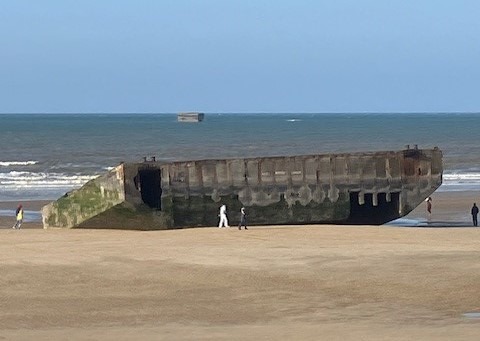
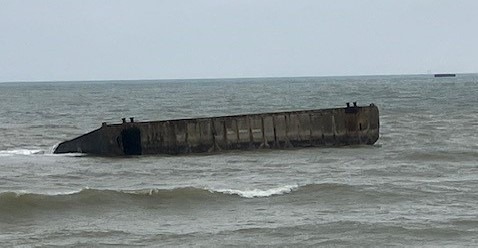
Next stop was in the town of Arromanches where warming coffee and hot chocolate was the order of the day. Arromanches was the site of the man-made Mulberry harbour and many of the sections of this famous harbour can still be viewed, and some of the nearer sections can be walked out to at low tide.
Suitably refreshed, we headed inland to Crepon, the scene of the only VC action on D-Day. With 150,000 men ashore by nightfall, and heavy fighting across more than fifty miles, it is quite amazing that only one VC should be won on this famous day.
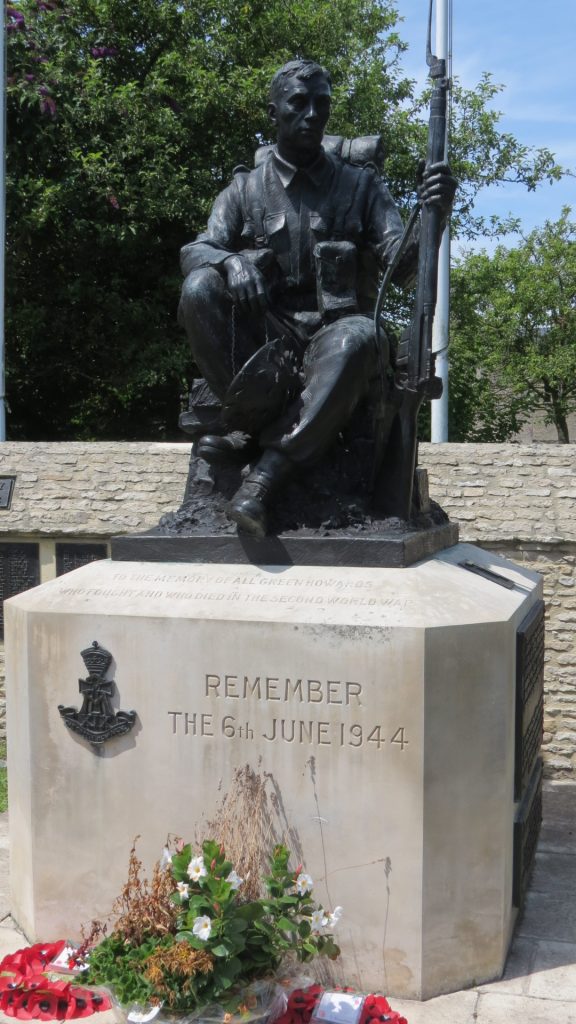
The Victoria Cross was awarded to CSM Stanley Elton Hollis of the 6th Battalion, Green Howards and the regimental memorial sits in a prominent location in the middle of the village of Crepon.
Just a further three miles from Crepon, you reach the village of Creully. The Manoir at Creully became Montgomery’s Normandy HQ after D-Day and the village is also the site of the impressive 4th/7th Dragoon Guards memorial.
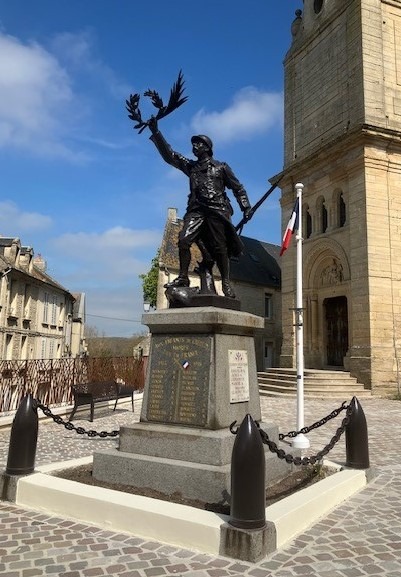
Creully village centre is well worth a visit if only for the superb Great War village memorial that sits outside the church. I think that this is a stunning example of Great War memorialisation and the victorious iconography of the laurel wreath is a wonderful example to behold. In many respects, it is somewhat amazing that the Germans did not destroy memorials like this between 1940-44.
We then retraced our steps to the British Normandy Memorial Park situated at Ver sur Mer. My wife and I first visited this new memorial park last June and yet it still stunned me by its design and expanse. There was also a new 70 tree avenue planted to commemorate Queen Elizabeth’s 70 years as our monarch, the trees having been supplied by the French.
It was at Ver sur Mer where we had arranged to meet up with Matt Kelly and his wife Cindy who happened to be in France and were travelling up to Normandy from Paris. Robin and I met Matt in March 2024 when we were in South Africa.
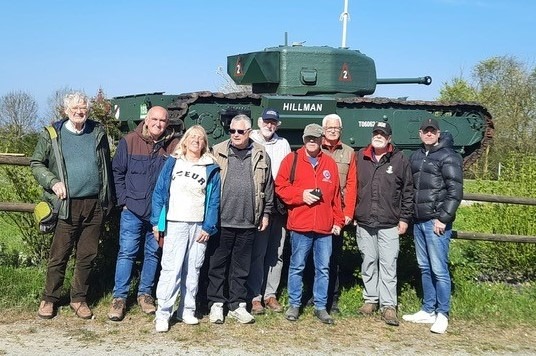
Matt and Cindy were accompanied by their guide, Margaret, an American who has lived near Utah beach for the last twenty-seven years. After a walk around the Memorial Park, the whole party headed for the Hillman Bunker complex.
The Hillman bunker complex was a substantial German command centre dominating the vista across the Cote de Nacre, spread over some 24 hectares, there were 18 large concrete bunkers with connecting tunnels and a substantial garrison well dug in to trenches, tobruks and machine gun pits, all behind layers of barbed wire.
The whole complex was attacked by men of the 1st Battalion Suffolk regiment later on in the day on the 6th June. The German high command and about 70 men barricaded themselves into the complex but accepted that they had no option but to open the doors and surrender on the 7th.
Today, thanks to the generosity of the landowner, the whole site is in the care of the Suffolk Regiment Association.
A further ten-minute drive took the tour party to the German Wurzberg radar station museum at Douvres La Deliverande. This is an excellent museum located deep within the German radar station bunkers and shows how the whole German radar operation was linked together from Norway to the Spanish border.
Sadly, half of the bunker complex is on land owned by a farmer, and for some reason, he won’t allow access to his bunkers, whilst the museum site is owned by the local community.
We all then returned to Arromanches, where the tide had now receded and I was able to re-photograph the Mulberry harbour section at low tide. A convivial dinner followed for the whole party before it was time to say goodbye to Matt, Cindy and Margaret and we headed back to our hotel in Caen.
You can get a feel for the size of the Mulberry Harbour when you see a human figure alongside.
Friday was re-loading the car day in readiness for the journey home, but not until 4.30pm. A trip to the supermarket for wine, and in my case, Lipton Yellow Label tea bags! (not readily available in the UK) was followed by a return to Bayeux to view the famous Bayeux Tapestry.
This superb piece of Norman propaganda was used in the late 11th Century to detail to a largely illiterate population, the reasons why William invaded England and defeated Harold at Hastings in 1066. The fact that it has survived so much turmoil over very nearly 1,000 years is probably one of the most remarkable aspects of the tapestry’s history.
I last visited the tapestry with my then young family in 1994 when all of Normandy was awash with bunting and flags for the 50th anniversary of D-Day. If you want to see this UNESCO ‘Memory Of The World’ exhibit, you will need to get yourself across to France before 1st September.
On 1st September, the tapestry and its museum will be closed for extensive renovation and re-modelling of the museum’s buildings and it will not re-open until October 2027.
Whilst in Bayeux, we then took a short walk to the town’s cathedral, a magnificent structure in the centre of the old town.
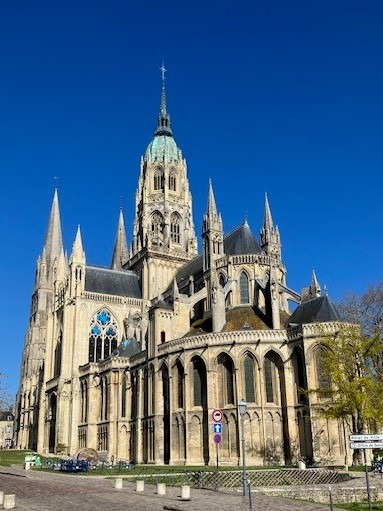
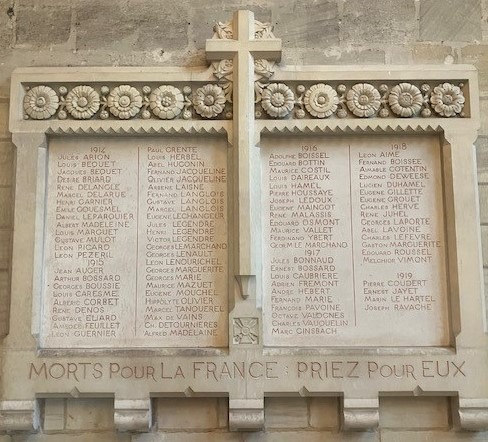
The cathedral is free to enter and is magnificent with its high vaulted ceilings and stained glass windows. As expected, the interior of the cathedral contains many war memorials both French and British and from both world wars.
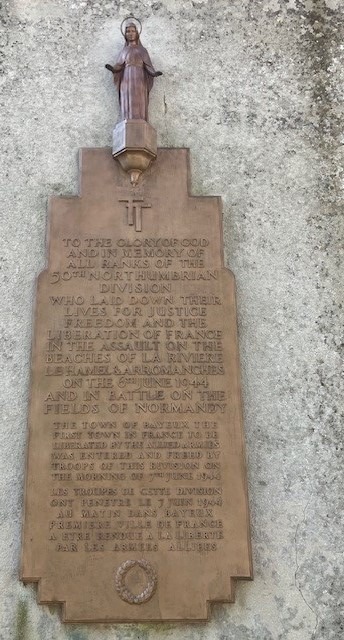
Leaving the cathedral, I spied a tablet on an adjacent wall and found it to be a D-Day memorial to all of the men of the 50th (Northumbrian) Division who landed on Sword beach on 6th June.
Returning to the car, we set off for a return to Pegasus Bridge and a baguette lunch at Café Gondree, arguably one of the first buildings to be liberated in the early hours of 6th June.
Our final stop was at Ouistreham port for a last beer in the sunshine before embarking aboard the ferry for the return crossing.
All in all, an excellent week in great weather and in good company. It is very possible to fit in a huge amount in four days if you are well prepared with an itinerary and the necessary maps. If this article has whet your appetite to make a visit, please do not hesitate to drop me a line for any help that you may require.
I should also like to thank Robin, Keith, Steve, Kevin, Margarita, Arthur, Philip, Nadine, Matt, Cindy, Margaret, and above all else, Frank for their support, and good cheer over the course of the week.