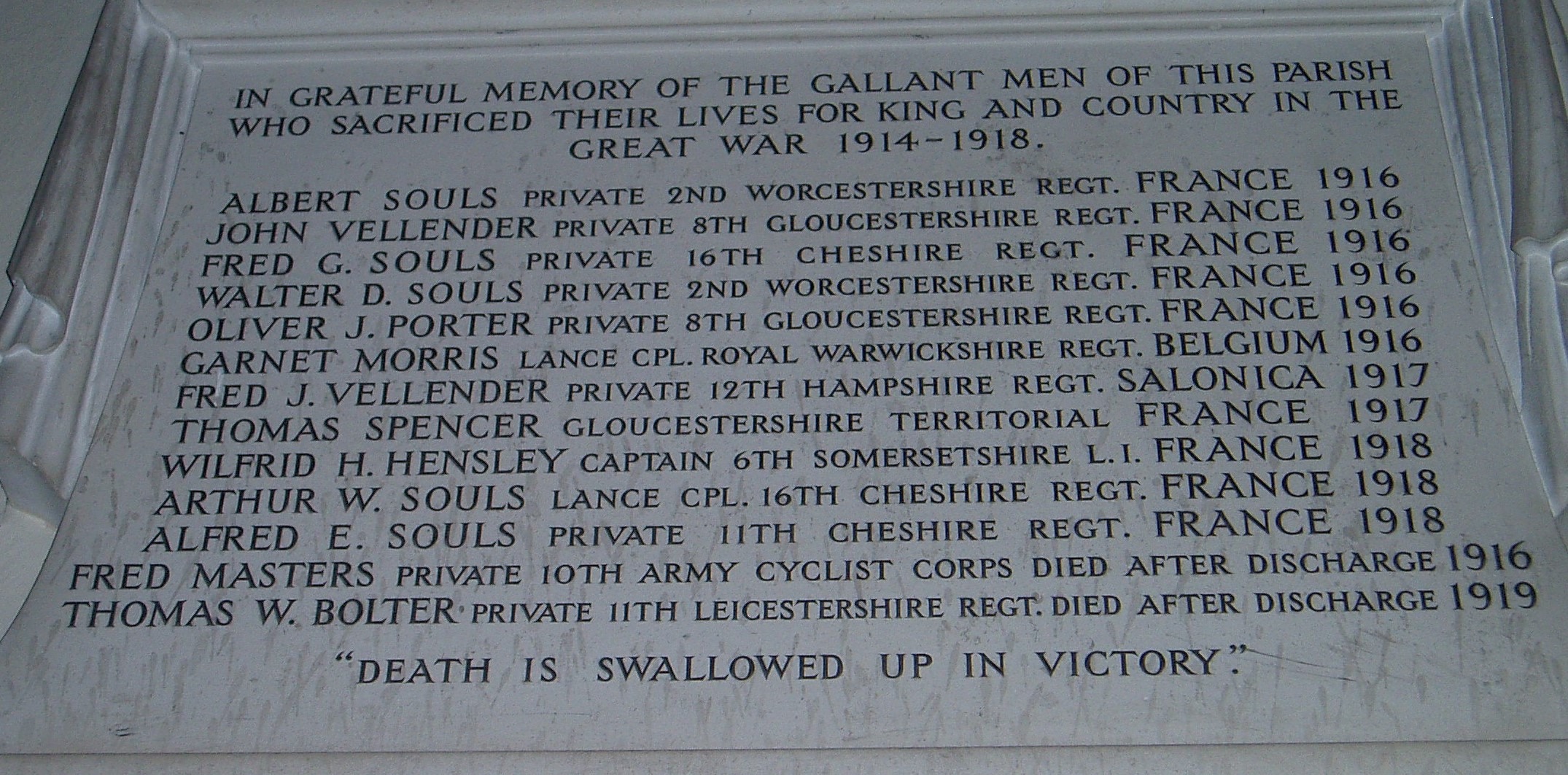
The Souls family of Great Rissington, Gloucestershire, became one of the most tragic symbols of the human cost of the First World War. William and Annie Souls were ordinary farm workers raising a large family of six sons and three daughters in a small Cotswold village. Like thousands of British families in 1914, they could never have imagined that the war would devastate their lives. By the time the conflict ended in 1918, five of their six sons had been killed while serving their country, leaving behind a story of extraordinary sacrifice and heartbreaking loss.
The Souls brothers were Albert, Walter, Frederick (Fred), Arthur, Alfred and Percy. When Britain entered the war, the five eldest brothers answered the call to serve. Albert and Walter joined the Worcestershire Regiment, while Fred and the identical twins Arthur and Alfred enlisted in the Cheshire Regiment’s “Bantam” battalion, a unit created for men who were shorter than the normal height requirement but otherwise fit for military service. Percy, the youngest brother, was too young to enlist.
The brothers experienced some of the fiercest fighting on the Western Front. Albert and Walter survived the Battle of Loos in 1915 before transferring to the Machine Gun Corps, one of the most dangerous branches of the British Army. Sadly, Albert became the first brother to die when he was killed in action in March 1916. His death marked the beginning of an unimaginable period of grief for the Souls family.
Only months later, tragedy struck again. Arthur was killed during the Battle of the Somme in July 1916 after displaying great bravery, for which he was posthumously recognised. Before the family had fully recovered from this devastating news, Alfred was killed in October 1916. In the space of a single year, Annie and William Souls had lost three sons.
The suffering did not end there. Walter was killed in 1917 while serving with the Machine Gun Corps. Finally, in 1918, Fred disappeared during fighting on the Western Front and was officially listed as missing, later presumed dead. His body was never recovered. Annie Souls reportedly kept a candle burning in the window of her home, hoping that one day Fred might return. Sadly, he never did. This simple act became a lasting symbol of a mother’s hope refusing to die, even when faced with overwhelming loss.
Although Percy survived the war because he was too young to fight, he later died from meningitis, meaning none of the six Souls brothers lived long lives. The family’s sacrifice became known throughout Britain and remains one of the most devastating examples of the impact of the First World War on ordinary families. In Great Rissington, memorials continue to honour the brothers, ensuring that their names and their sacrifice are not forgotten.
The story of the Souls family reminds us that behind every military statistic were real people with hopes, dreams and families. William and Annie Souls lost nearly everything the war could take from them. Their experience reflects the immense human cost of the First World War and serves as a powerful reminder of the price paid by countless families across Britain. More than a century later, the memory of the Souls brothers continues to stand as a symbol of courage, duty and unimaginable sacrifice.
Known British families who lost five sons include:
- The Souls family (Great Rissington, Gloucestershire) – William and Annie Souls lost Albert, Walter, Frederick, Arthur and Alfred.
- The Beechey family (Lincoln) – Amy Beechey lost five of her eight sons. When Queen Mary thanked her for her sacrifice, Amy famously replied: “It was no sacrifice, Ma’am. I did not give them willingly.”
- The Smith family (Barnard Castle, County Durham) – John and Margaret Smith lost five of their six sons.
- The Baldock-Apps family (Hurst Green, East Sussex) – identified through recent pension-card research as another family who lost five sons.
- The Richardson family (Nottingham) – recognised in 2025 after pension records revealed Ellen Richardson lost five sons in the war.
- The Hoult family (Derbyshire) – later research concluded five sons died as a consequence of their war service, although two of the deaths occurred after the Armistice from war-related illness.
As for families who lost more than five sons, they were extraordinarily rare in Britain. There are no widely accepted British examples of six sons all killed during the First World War. The Smith family of Yongala in South Australia is often cited as losing six sons, but that was an Australian family, not a British one.