

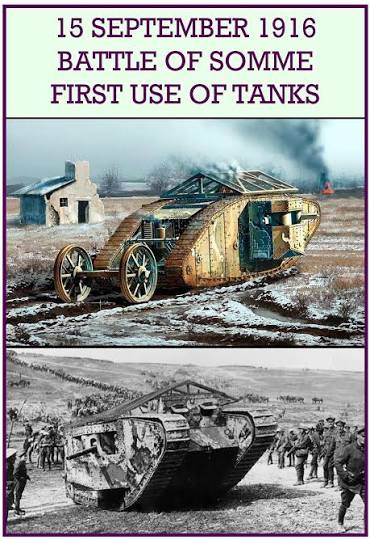
September 15th, sees the 109th anniversary of the first tanks in history going in to battle on the Somme. We are all rightly proud of the fact that these first tanks were designed and built in Lincoln, but what did they actually achieve?
Commander in Chief, Sir Douglas Haig, made the decision to commit the first 49 Mark I tanks on 15th September 1916 between the villages of Flers and Courcelette. Undoubtedly, he could have waited until a greater number of tanks were available and of the 49 that were committed to battle, only 32 made it to the start line due mainly to mechanical failure.
The tanks were deployed in small groups of 2 or 3 to accompany the infantry, in their frontal attack. Only 18 tanks were deemed to have taken a significant part in the battle, the others broke down or ditched in shell holes.
Nevertheless, the sight of these rumbling 30 ton monsters petrified the German defenders and where the tanks remained in action, British objectives were taken.
The British press reported; “When the German outposts crept out of their dugouts in the mist of the morning of 15 September and stretched to look for the English, their blood was chilled to their veins. Two mysterious monsters were crawling towards them over the craters. Stunned as if an earthquake had burst around them, they all rubbed their eyes, which were fascinated by the fabulous creatures.”

The British gains on this day were some 2,500 yards on a three-mile front, a major but limited breach of the German second line of resistance. The trouble with launching a completely new and untried weapon was that no one in high command had any idea what the tanks were capable of, and nor did any of the junior field commanders understand the necessity of infantry and tank co-operation. Indeed, many of the men crewing and commanding the tanks had never been in action before, by and large, the men of the Heavy Branch Machine Gun Corps on this day were young and inexperienced.
After the action, Gunner William Dawson stated; “Our tank commander was 2nd Lt. Macpherson, a fine and likeable young fellow, but he like all of us had never been on a battlefield or in action before. Indeed, that was the position of practically the whole of the 32 tanks which took part in this first action. The briefing and instructions regarding objectives were quite inadequate and there was little or no co-operation between the infantry and the tanks.”
As Britain came to terms with the losses in men sustained in July on the Somme, the introduction and action of the tanks gave a very timely uplift to public morale, and gave a great filip to the government propagandists who were able to use the new wonder weapon in their press releases, where probably the most reproduced and famous quotation from this action came from a Royal Flying Corps pilot who reported; “A tank is walking down the High Street of Flers with the British Army cheering behind.” Such offerings were a great boost to the public.
After September 15th, the MKI tank was now known to be unreliable, mechanically deficient in many areas, e.g. they did not have external exhaust systems and painfully slow, but they did give a glimpse of what may be possible in the future. It would take another fourteen months before the full weight of the tank’s capabilities would be showcased at Cambrai in 1917, and even then, the high command could not take advantage of the tank’s success on 20th November – it was a very slow and painful ‘learning curve,’ and sadly, a learning curve that the British did not build upon between the wars, so that when the Germans launched their western offensive in May 1940, their tanks outgunned and out manoeuvred the armour of the BEF and their French allies.
However, at the end of the September 1916 battle, Sir Douglas Haig noted; “Wherever the tanks advanced, we took our objectives and where they did not advance, we failed to take our objectives. Go back and make as many more tanks as you can.”

Leave a Reply