

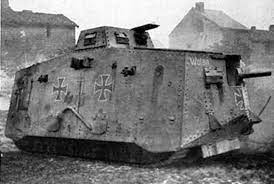
The first tank-versus-tank battle in history took place on 24th April 1918 near the French village of Villers-Bretonneux, during the German Spring Offensive of the First World War. Tanks had already been used for nearly two years, but always against infantry, wire, and fortifications. At Villers-Bretonneux, however, armoured vehicles would confront one another directly for the first time, marking a turning point in mechanised warfare and foreshadowing the armoured battles that would define future conflict in the twentieth century.
By April 1918, the German Army had launched a series of offensives intended to break the Allied line before American forces could arrive in strength. Villers-Bretonneux, east of Amiens, was strategically important because it overlooked rail lines supplying British forces. On the morning of 24th April, German infantry advanced toward the village supported by a small number of A7V tanks, the only type of tank Germany had manufactured during the war. These machines were large, boxy, and heavily armoured, mounting a forward 57 mm gun and multiple machine guns. Although formidable, they were few in number and mechanically unreliable. Nevertheless, their appearance on the battlefield was psychologically significant, particularly because British troops had previously enjoyed a near monopoly over the use of tanks.
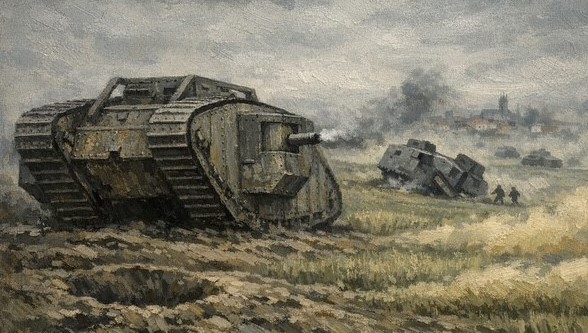
Opposing them were British Mark IV tanks from A Company of the 1st Battalion, Tank Corps. The Mark IV existed in two main variants: “male” tanks armed with 6-pounder guns in side sponsons, and “female” tanks armed only with machine guns. Lieutenant Frank Mitchell commanded a male Mark IV, accompanied by two female tanks. As German infantry advanced under morning mist, three A7Vs moved forward in support. One of these, often identified as “Nixe,” led the formation, while the other two followed at some distance.
Visibility was poor, and both sides encountered one another unexpectedly. The two British female tanks quickly found themselves at a disadvantage. Their machine guns could not penetrate the armour of the German vehicles, while the German 57 mm gun posed a serious threat. Under fire, the female tanks withdrew, leaving Mitchell’s male Mark IV alone to face the advancing A7Vs. The situation was unprecedented: two opposing tanks manoeuvring against each other across churned, shell-torn ground.
Mitchell ordered his driver to halt and fire. The Mark IV’s 6-pounder guns, mounted in side sponsons, required the entire vehicle to be aligned carefully to bring the guns to bear. The rough ground made accurate firing difficult, and the tank rocked violently after each shot. The German A7V fired first but missed. Mitchell then advanced slightly to steady his vehicle, allowing his gunners to aim more effectively. After several rounds, British shells struck the lead A7V. One hit damaged its steering gear, while another reportedly penetrated armour and caused casualties among the crew. The German tank began to tilt as it attempted to withdraw, eventually becoming immobilised. Surviving crew members abandoned it under fire.
The remaining two A7Vs, observing the fate of their companion and under pressure from British artillery and infantry, withdrew rather than continue the engagement. This brief but decisive exchange constituted the first tank-versus-tank combat in history. Mitchell’s Mark IV, however, did not escape unscathed. German artillery began targeting the lone British tank, and the crew endured heavy shelling. Eventually, after supporting nearby infantry, Mitchell’s vehicle was hit and damaged, forcing the crew to abandon it later in the action.
The fighting around Villers-Bretonneux did not end with this duel. Later that day, British Whippet medium tanks counterattacked German infantry in the same sector, demonstrating the growing tactical experimentation with armoured forces. These lighter, faster vehicles inflicted significant casualties but also suffered losses, highlighting both the potential and vulnerability of early tanks. By nightfall, Australian and British infantry launched a coordinated counterattack that recaptured Villers-Bretonneux, stabilising the front near Amiens.
Although small in scale, the tank duel at Villers-Bretonneux had outsized symbolic importance. It demonstrated that tanks would not merely support infantry but would eventually confront one another directly. The engagement also revealed key tactical lessons. Armament mattered: the British male tank’s cannon proved decisive against the machine-gun-armed female tanks’ inability to engage armoured targets. Mobility and visibility were equally crucial; both sides struggled with rough terrain, limited sightlines, and the need to reposition entire vehicles to aim effectively. These challenges would influence later tank design, encouraging rotating turrets, improved optics, and better suspension systems.
The encounter also underscored the psychological dimension of armoured warfare. Infantry on both sides reacted strongly to the presence of tanks, often clustering around them for protection or withdrawing in fear. The destruction of a tank by another tank demonstrated that armoured vehicles were not invulnerable, shaping expectations for future engagements. Within two decades, tank-versus-tank combat would become central to military planning, particularly during the Second World War.
In retrospect, the clash at Villers-Bretonneux appears modest: only a handful of tanks firing at relatively short range. Yet it represented the birth of a new form of combat. For the first time, armoured machines designed to break trench stalemates turned their weapons on each other, inaugurating an era in which battles between tanks would play decisive roles on battlefields around the world. The events of 24th April 1918 thus stand as a milestone in military history, marking the moment when armoured warfare began to evolve beyond its experimental origins into a defining feature of modern war.
Leave a Reply