

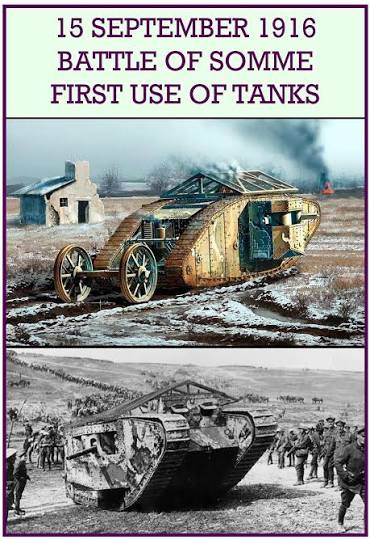
The first use of tanks in warfare took place during the Battle of the Somme on 15 September 1916. The British introduced a new type of armoured fighting vehicle, known as the tank, in an attempt to break through the German defensive system and overcome the problems that had made attacks on the Western Front so difficult. Although the first tank attack was only partially successful, it marked an important moment in military history. The appearance of tanks demonstrated the potential of mechanised warfare and eventually transformed the way armies fought.
The idea of developing an armoured vehicle capable of crossing trenches and protecting its crew from machine-gun fire had emerged from the conditions of trench warfare. Since 1914, the Western Front had become dominated by long lines of trenches, barbed wire, machine guns and artillery. Traditional infantry attacks were extremely costly because soldiers had to cross open ground while exposed to enemy fire. Cavalry, which had previously played an important role in warfare, was largely ineffective against these defensive systems.
British military and political leaders therefore became interested in developing a vehicle that could cross difficult terrain, destroy barbed wire and provide protection for infantry. The Landships Committee was established in 1915 to investigate the possibilities of such a machine. Engineers and manufacturers developed several experimental designs. The term “tank” was adopted partly as a security measure: early vehicles were described as tanks or water carriers in order to disguise their true purpose.
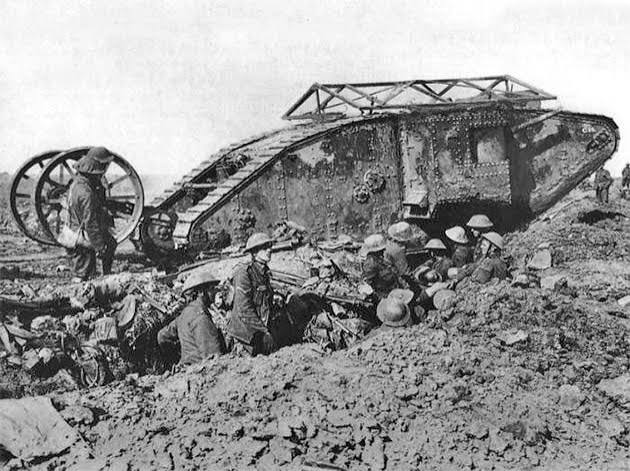
The first operational tanks were the British Mark I. They were enormous machines, weighing around 28 tons, and were divided into two main versions. “Male” tanks carried heavier guns, including 6-pounder naval guns, while “female” tanks carried machine guns. They were powered by petrol engines and had a maximum speed of only a few miles per hour. Their armour was designed primarily to protect their crews from small-arms fire and shell fragments.
The tanks were extremely difficult to operate. Conditions inside were hot, noisy and uncomfortable, while fumes from the engine could make breathing difficult. Communication between crew members was also challenging. The vehicles had poor visibility and were mechanically unreliable. Nevertheless, military planners believed that their ability to cross trenches and withstand machine-gun fire could make them valuable on the battlefield.
The British decided to use tanks during the Somme offensive in September 1916. The Battle of the Somme had begun on 1 July and had already resulted in enormous casualties. The British and French armies had struggled to make a decisive breakthrough against German defensive positions. By September, British commanders hoped that tanks might help infantry capture German trenches and strengthen an attack in the area around Flers and Courcelette.
The tank attack began on the morning of 15 September. Around 49 tanks had been allocated for the operation, although only about 32 reached their starting positions in time to participate. Some broke down before the attack began, while others became stuck in the difficult terrain. The tanks were organised to support infantry attacks across a broad section of the front.
At approximately 6:20 a.m., the infantry assault began. The tanks moved forward behind or alongside the advancing soldiers. Their appearance had a psychological effect on the German defenders. No German soldiers had ever encountered such vehicles before and were reportedly shocked by their presence. Tanks could cross shell holes and trenches that would have stopped ordinary vehicles, and their armour offered some protection from rifle and machine-gun fire.
One of the most successful tanks was known as “D 17”, nicknamed “Dinnaken”. It advanced towards the German defensive position at Flers and played an important role in helping British troops capture the village. Other tanks also contributed to the advance, although their performance varied considerably.
The attack nevertheless revealed the serious limitations of the new weapon. Many tanks broke down because their mechanical systems were unreliable. Others became stuck in mud or shell craters. Some could not keep up with the infantry. Their slow speed also made them vulnerable to artillery. German soldiers soon discovered that artillery shells could destroy or disable tanks, while their crews were vulnerable if the vehicles became immobilised.
The terrain of the Somme was another major problem. Years of artillery bombardment had transformed the battlefield into a landscape of deep shell craters, mud and damaged trenches. Tanks had been designed to cross difficult ground, but even they could not easily cope with every obstacle. Their tracks frequently broke, and their engines overheated.
Despite these problems, the attack at Flers-Courcelette achieved some important successes. British troops captured the village of Flers and advanced several thousand yards in places. The tanks contributed to this success, particularly by helping infantry overcome machine-gun positions and by creating confusion among German defenders.
However, the tanks did not produce the breakthrough that British commanders had hoped for. Their numbers were too small, their reliability was poor and there had been insufficient experience in coordinating them with infantry and artillery. The first use of tanks was therefore an experiment rather than a decisive military revolution.
The reaction to the tanks was mixed. Some British commanders were impressed by their potential, while others believed that they were unreliable and unsuitable for warfare. The tank’s advocates argued that the problems experienced on 15 September could be solved through better design, training and tactics. Over the following years, tanks became increasingly important as the British Army learned how to use them more effectively.
The first tank battle also had an important psychological significance. The German Army now knew that the Allies possessed a new weapon capable of crossing trenches and resisting small-arms fire. Although German forces developed methods of combating tanks, the appearance of armoured vehicles contributed to the wider development of combined-arms warfare.
The experience of 15 September 1916 led to improvements in tank design. Later British tanks were generally more reliable and were designed with the lessons of the Somme in mind. Tanks were increasingly used alongside infantry, artillery and aircraft rather than being treated as an independent weapon. This approach became particularly important during later battles, including the Battle of Cambrai in November 1917, when the British used hundreds of tanks in a much larger and more coordinated operation.
The first use of tanks on 15 September 1916 was therefore both a failure and a success. It was a failure in the sense that the tanks did not achieve the breakthrough that their supporters had hoped for, and most of the vehicles were lost through mechanical failure, enemy action or difficult terrain. However, it was a success because it demonstrated that armoured vehicles had a genuine role to play on the battlefield.
The introduction of tanks was one of the most significant technological developments of the First World War. The Western Front had created a military problem that traditional weapons could not easily solve. Tanks offered a possible answer by combining armour, firepower and mobility. Their first appearance at Flers-Courcelette showed both their potential and their weaknesses.
Ultimately, 15 September 1916 should be remembered as the beginning of modern armoured warfare rather than as a decisive tank victory. The tanks used that day were primitive, slow and mechanically unreliable, but they represented the beginning of a major change in military technology. Within a few decades, tanks would become central to warfare. The machines that first appeared on the Somme were far from perfect, but their debut demonstrated that the battlefield of the future would increasingly depend on mechanisation and mobile firepower.
Leave a Reply