

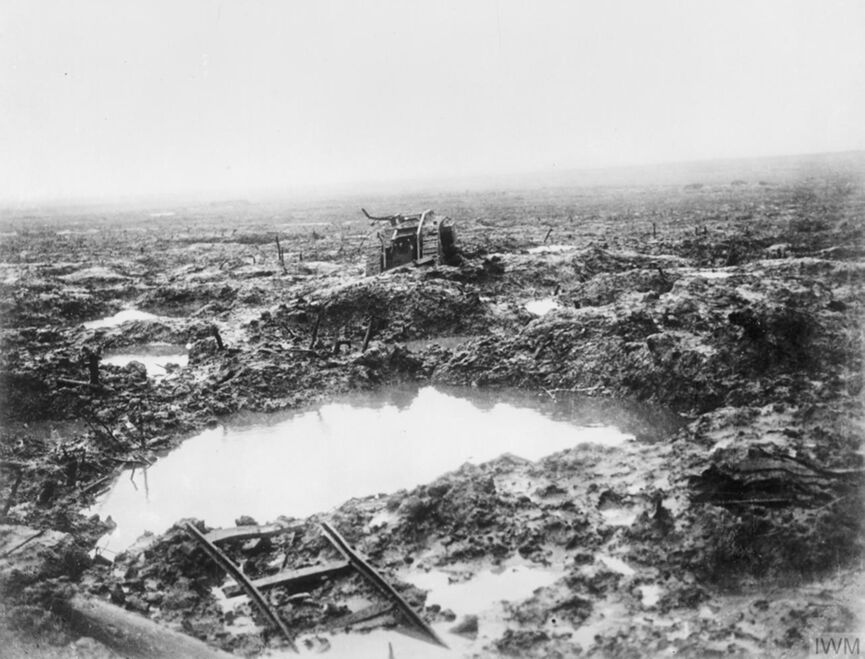
After the horrendous 1917 fighting in the Flanders mud that we know as Passchendaele, the British Prime Minister, David Lloyd George, was horrified by the conditions and the casualty list, or ‘butcher’s bill’ as it was referred to.
Lloyd George was set to sack the C-in-C, Sir Douglas Haig, but none of the likely replacements, Gough, Plumer, Rawlinson, Allenby etc. would commit to the role, and all pledged loyalty to Haig.
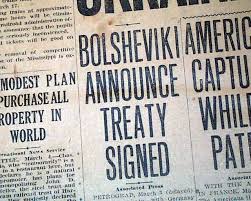
As the now Bolshevik led Russia had made peace with Germany in February 1918, it was common knowledge that the Germans would move up to 500,000 men from the Eastern Front to the Western Front, and attempt one last major offensive in the west to either defeat the Anglo-French armies, or so weaken their position that Germany’s position at a peace conference would be strengthened. The backdrop to all of this, was the continuing arrival of tens of thousands of fresh new American ‘Dough Boys’ in France, which Ludendorff and the Kaiser knew would tip the scales against them later in 1918.
With Lloyd George unable to remove Haig, his attentions turned to Lincolnshire’s local hero, Sir William Robertson, who as Chief of the Imperial General Staff, was the conduit between the generals and the politicians back in London.
Therefore, the resignation of Sir William Robertson as Chief of the Imperial General Staff (CIGS) in February 1918, 108 years ago this week, marked a pivotal moment in the friction between Britain’s military leadership and its political directorate during the First World War. Known affectionately as “Wully,” Robertson was a singular figure in British history—the only man to rise from the rank of Private to Field Marshal.
However, Robertson’s steadfast commitment to Haig and to “Westernism”—the belief that the war could only be won by defeating the German Army on the Western Front—placed him on a collision course with the Prime Minister.
By early 1918, Lloyd George had grown weary of the staggering casualties at battles like Passchendaele and Robertson’s refusal to consider “knocking out the props” (that is, attacking Germany’s allies in the East). To circumvent Robertson’s authority, the Prime Minister championed the creation of the Supreme War Council at Versailles. This body was designed to centralise Allied strategy, but Robertson viewed it as a dangerous dilution of his power and a threat to the constitutional principle that the CIGS should be the government’s sole military advisor.
The crisis peaked when Lloyd George offered Robertson a choice: remain CIGS with diminished powers or move to Versailles. Robertson, viewing the new arrangement as unworkable and strategically unsound, refused both and was forced to resign on 11 February 1918. His departure removed the last major institutional barrier to Lloyd George’s control over military policy, yet it also highlighted the deep-seated tensions between the “frock coats” (politicians) and the “brass hats” (generals) that defined the British war effort between 1914-18.
Robertson was replaced as CIGS by Sir Henry Wilson, a man whose methods and thinking differed from Robertson’s rigid and forthright views.
Wilson was a “political general” who possessed the communication skills to explain complex military situations to civilians in a way that Lloyd George appreciated. He was willing to compromise on institutional structures, such as the Supreme War Council, which Robertson had found unacceptable.
This suited Lloyd George’s approach to what became the final year of the war, as Lloyd George, a most-shrewd politician, had at all times, one eye on the next General Election; and he knew that to win the election, he not only had to win the war, but he had to keep Haig and the Generals on a tight leash so as to minimise the final total of casualties and deaths. A political policy that very nearly lost the war in April 1918!
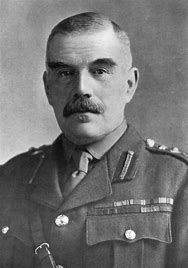
Sir William Robertson
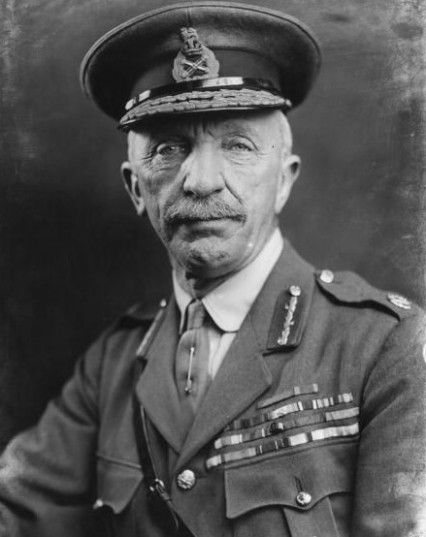
Sir Henry Wilson
Leave a Reply