
The Treaty of Brest-Litovsk was a peace treaty signed on March 3, 1918, between the new Bolshevik government of Soviet Russia and the Central Powers (Germany, Austria-Hungary, Bulgaria, and the Ottoman Empire), that ended Russia’s participation in World War I. The treaty was signed at Brest-Litovsk after two months of negotiations and was forced on the Bolshevik government by the threat of further advances by German and Austrian forces. According to the treaty, Soviet Russia defaulted on all of Imperial Russia’s commitments to the Triple Entente alliance.
The treaty was effectively terminated in November 1918 when Germany surrendered to the Allies. However, in the meantime it provided some relief to the Bolsheviks, already fighting the Russian Civil War, by the renouncement of Russia’s claims on Poland, Finland, Estonia, Latvia, Belarus, Ukraine, and Lithuania.
On December 15, 1917, an armistice between Soviet Russia and the Central Powers was concluded and fighting stopped. On December 22, peace negotiations began at Brest-Litovsk. The Treaty of Brest-Litovsk was signed on March 3, 1918. The signatories were Bolshevik Russia signed by Grigori Yakovlovich Sokolnikov on the one side and the German Empire, Austria-Hungary, Bulgaria, and Ottoman Empire on the other. The treaty marked Russia’s final withdrawal from World War I as an enemy of her co-signatories, on unexpectedly humiliating terms.
The Treaty of Brest-Litovsk marked a significant contraction of the territory controlled by the Bolsheviks or that they could lay claim to as effective successors of the Russian Empire. While the independence of Finland and Poland was already accepted in principle, the loss of Ukraine and the Baltics created, from the Bolshevik perspective, dangerous bases of anti-Bolshevik military activity in the subsequent Russian Civil War (1918–1922). Indeed, many Russian nationalists and some revolutionaries were furious at the Bolsheviks’ acceptance of the treaty and joined forces to fight them. Non-Russians who inhabited the lands lost by Bolshevik Russia in the treaty saw the changes as an opportunity to set up independent states not under Bolshevik rule.
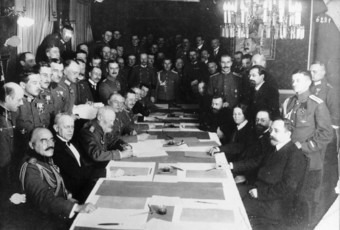
The signing of the treaty.
Leave a Reply