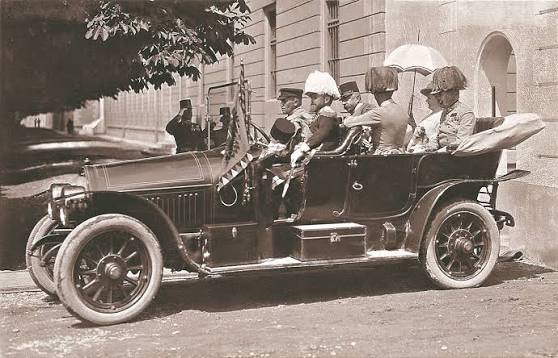
On 28 June 1914, Archduke Franz Ferdinand, heir to the Austro-Hungarian throne, visited Sarajevo, the capital of Bosnia and Herzegovina, accompanied by his wife, Sophie, Duchess of Hohenberg. The visit was intended to inspect imperial military exercises and demonstrate the authority of the Austro-Hungarian Empire over the recently annexed territory. However, the trip became one of the most significant events in modern history because it ended with the assassination that triggered the First World War.
Sarajevo was a city marked by political tension and nationalist sentiment. Many Slavic nationalists opposed Austro-Hungarian rule and sought independence or union with neighbouring Serbia. Among these groups was the secret organisation known as the Black Hand, which supported revolutionary activities against the empire. Several young Bosnian Serb conspirators, including Gavrilo Princip, were positioned along the Archduke’s planned route through the city.
The royal couple arrived by train in the morning and proceeded in an open-top motorcar through Sarajevo’s streets. Crowds gathered to watch the procession, while local officials accompanied the visitors. During the journey, one of the conspirators, Nedeljko Čabrinović, threw a bomb at the Archduke’s car. The explosive bounced off the folded roof of the vehicle and detonated under the following car, injuring several officers and bystanders. Franz Ferdinand remained unharmed and continued to the town hall despite the attack.
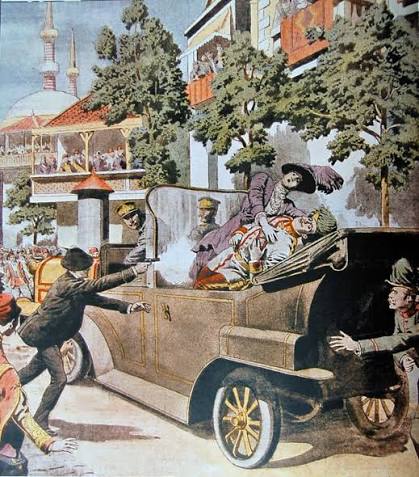
At the town hall, the Archduke reportedly expressed anger that he had been welcomed with bombs instead of greetings. Nevertheless, he completed the official reception before deciding to visit the wounded victims in hospital. To reach the hospital, the motorcade altered its planned route. Unfortunately, the driver was not informed of the change and made a wrong turn onto a side street. As the vehicle stopped to reverse, it came to a halt directly in front of Gavrilo Princip, who had earlier believed the assassination attempt had failed.
Recognising the unexpected opportunity, Princip stepped forward and fired two shots at close range. One bullet struck Sophie, while the other hit Franz Ferdinand in the neck. Both were fatally wounded and died shortly afterwards. Their deaths shocked Europe and created an international crisis.
The assassination had consequences far beyond Sarajevo. Austria-Hungary blamed Serbia for supporting nationalist groups involved in the plot and issued a strict ultimatum. Diplomatic tensions escalated rapidly as alliances between European powers came into effect. Within weeks, Austria-Hungary declared war on Serbia, drawing Russia, Germany, France, and Britain into the conflict. What began as the murder of a royal couple soon developed into the First World War, a devastating conflict that changed the political map of Europe and claimed millions of lives.
Today, the visit of Archduke Franz Ferdinand to Sarajevo is remembered as a turning point in world history. The events of that day demonstrate how a single incident, influenced by political unrest and nationalism, can have enormous and lasting global consequences.
Leave a Reply