

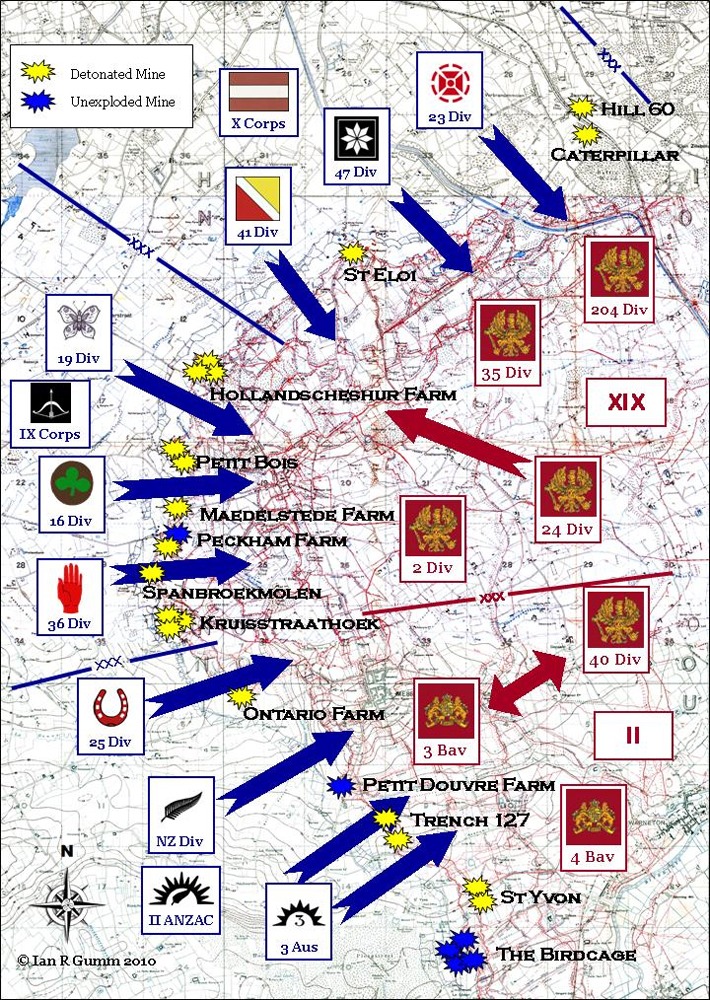
The Battle of Messines.
The Battle of Messines, fought on 7 June 1917 during the First World War, was one of the most significant and carefully planned Allied victories on the Western Front. Although often overshadowed by larger and bloodier battles such as the Somme and Passchendaele, Messines was an important military success that demonstrated the value of preparation, engineering innovation, and tactical coordination. It marked a turning point in British offensive operations in 1917 and provided an example of how modern warfare could be fought effectively against entrenched positions. The battle’s importance lies in its strategic context, its use of innovative military techniques, its psychological effect on both sides, and its influence on later operations during the war.
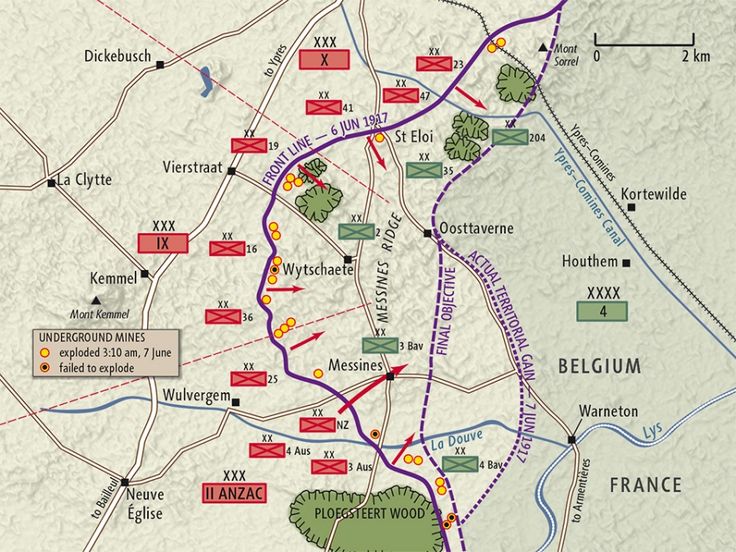
The Battle of Messines took place near the village of Messines in Belgium, south of Ypres. This area had been under German control since 1914 and formed part of a strategically important ridge that overlooked British positions in the Ypres salient. The Germans held the high ground, which gave them a major advantage for observation and artillery targeting. British troops stationed below were vulnerable to enemy fire and found it difficult to prepare offensives without being seen. Capturing the Messines Ridge was therefore essential if the British were to improve their defensive position and launch future attacks in Flanders.
The battle was planned by General Sir Herbert Plumer, commander of the British Second Army. Plumer believed in careful, methodical warfare rather than the large-scale frontal assaults that had caused such devastating losses earlier in the war. He insisted on detailed preparation, coordination between infantry and artillery, and clear objectives. His planning for Messines reflected lessons learned from previous failures on the Western Front, particularly the Somme in 1916, where poor coordination and over-optimism had led to disaster.
One of the most remarkable aspects of the battle was the extensive mining operation carried out by British tunnelling companies. For more than a year before the attack, British engineers secretly dug deep tunnels beneath German positions and placed enormous charges of explosives underneath key points on the ridge. In total, nineteen mines were prepared, containing over 450 tons of ammonal explosive. The work was extremely dangerous, as German tunnellers were also digging underground and counter-mining in an attempt to detect and destroy Allied tunnels. Despite these risks, the British completed the operation in secrecy.
At 3:10 a.m. on 7 June 1917, the mines were detonated simultaneously. The explosions were among the largest man-made blasts in history up to that point and could reportedly be heard as far away as London. Thousands of German soldiers were killed instantly, and huge craters destroyed entire sections of the German front line. The shock and confusion caused by the explosions gave the British infantry a major advantage as they advanced behind a creeping artillery barrage.
The detonation of the mines was not only a tactical success but also a psychological weapon. The scale of destruction was unprecedented and deeply shocked German defenders. Survivors were often disoriented and unable to organise resistance. This demonstrated the growing role of psychological warfare in modern conflict, where surprise and morale could be as important as physical force. For British troops, the explosions boosted confidence and created momentum for the attack.
Leave a Reply